Noah Matteucci
Instructions:
STEP 1: Roll a six-sided die.
STEP 2: Read the section that matches your roll.
STEP 3: Repeat step 1.
ONE
The Sum of Things is a series of woodcuts made from computer-generated “random walks.” Using the open-source Processing language, I write looping algorithms that move a square across a grid according to the laws of chance. A random number generator selects values from one to four, with each number assigned a direction along the grid’s x and y axes: the square “walks” either up, down, left, or right. Depending on the variables chosen, the color of the square changes — sometimes assigned randomly, sometimes alternating between black and white, or cycling between CMYK process colors. After running the program 1,000 times, the resulting image is saved and then engraved onto a woodblock using a laser cutter. The block’s grain is “raised” using a wire brush and the walk is nested within it like a jigsaw puzzle. When printed, two forms of chance are merged on paper: the geometric random walk and the natural patterns of the wood grain.
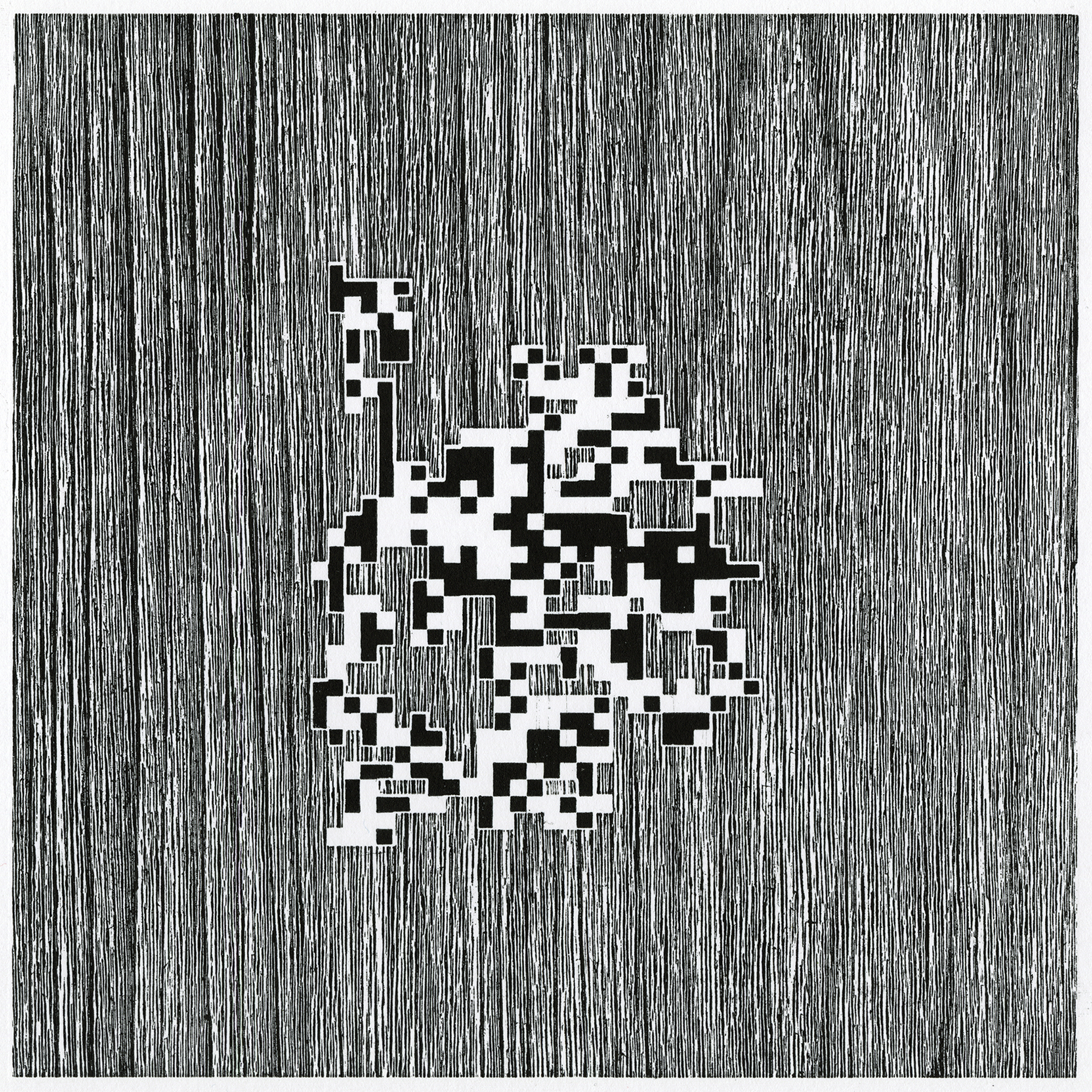
Thing 4, Woodcut, 8”x8”, 2025
TWO
To me, computer codes are extensions of traditional printmaking processes — follow a set of repeated instructions to produce a number of outcomes or prints. Even the proofing involved in printing an edition mirrors the debugging and tweaking of writing code. It’s full of trial and error, frustrations and failures, but also exciting accidents and possibilities. There’s no hard boundary between the digital and the physical world. The action of manually hand-printing a woodcut is simply the performance of an analog algorithm — every pulled print an iteration of the program. Process always outweighs outcome, because there really is no final outcome, because there really is no end. Just make more copies. We are all nested loops, arranging the already-made into the already-made again. Nothing that repeats is the same. Nothing that repeats is the same.
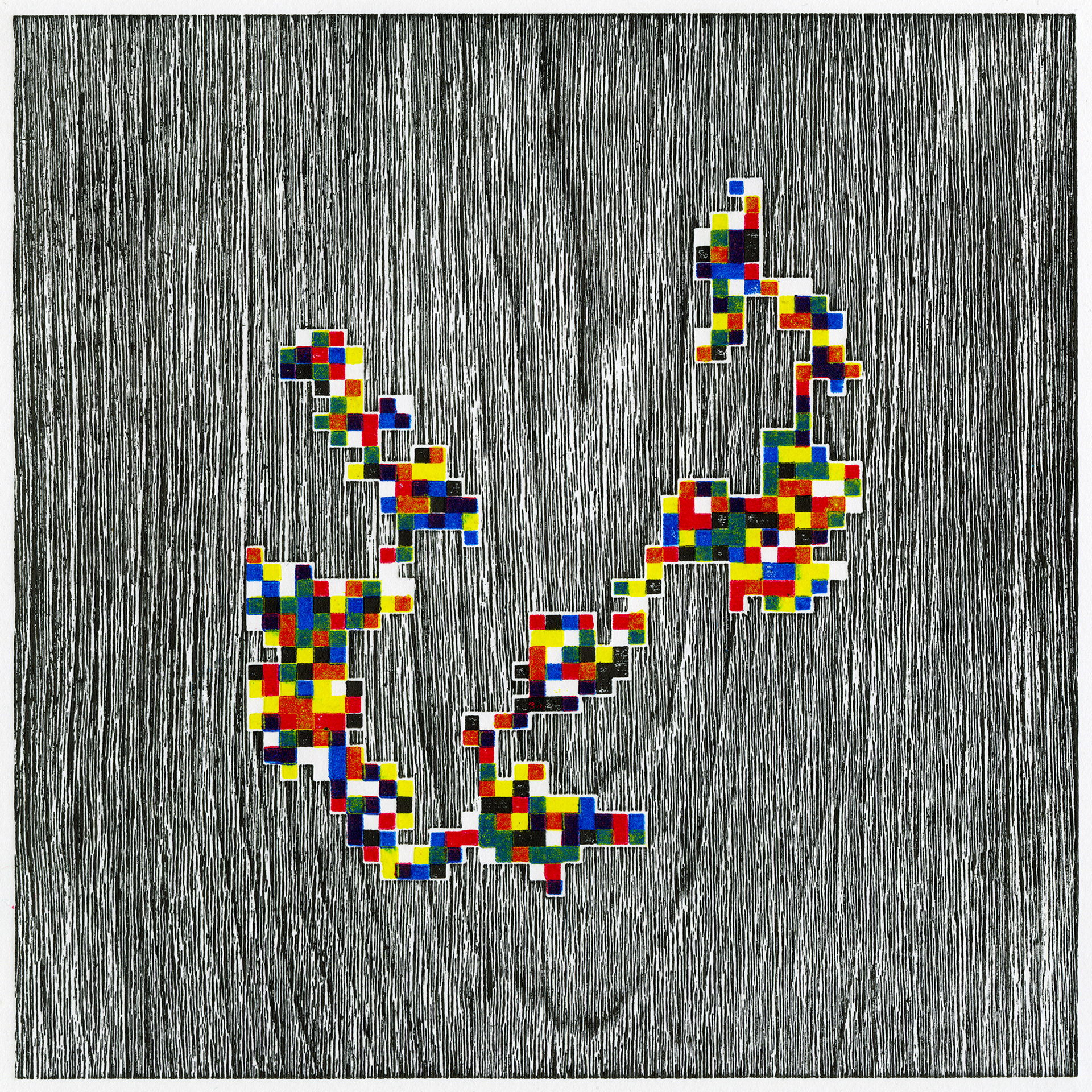
Thing 5, Woodcut, 8”x8”, 2025
THREE
My high school math teacher once split us up into two groups for an experiment. One group was instructed to flip a coin 100 times and record the results. The other group was told to simulate 100 coin flips — to write down a sequence of heads and tails as if they flipped an actual coin. The teacher announced, with a knowing smile, that she could guess which results were faked just by looking at them. She left the room and the monotonous coin flipping (and non-flipping) began. Our teacher returned when the results were compiled, and within seconds she pointed to the fake results. Dumbfounded, we listened as she explained that true randomness contains patterns — if you repeat something often enough, long runs of the same result are not only possible, but likely. The faked, human results avoided these long repetitions. Two things immediately became apparent. One: our teacher had just taken a thirty-minute break, and two: not only does chaos contain order, but the appearance of order may be, at bottom, chaos. Which raises the question — what if the order we see in the world is really just a long sequence of heads? What happens when it flips tails? Chaos and order are two sides of the same coin.
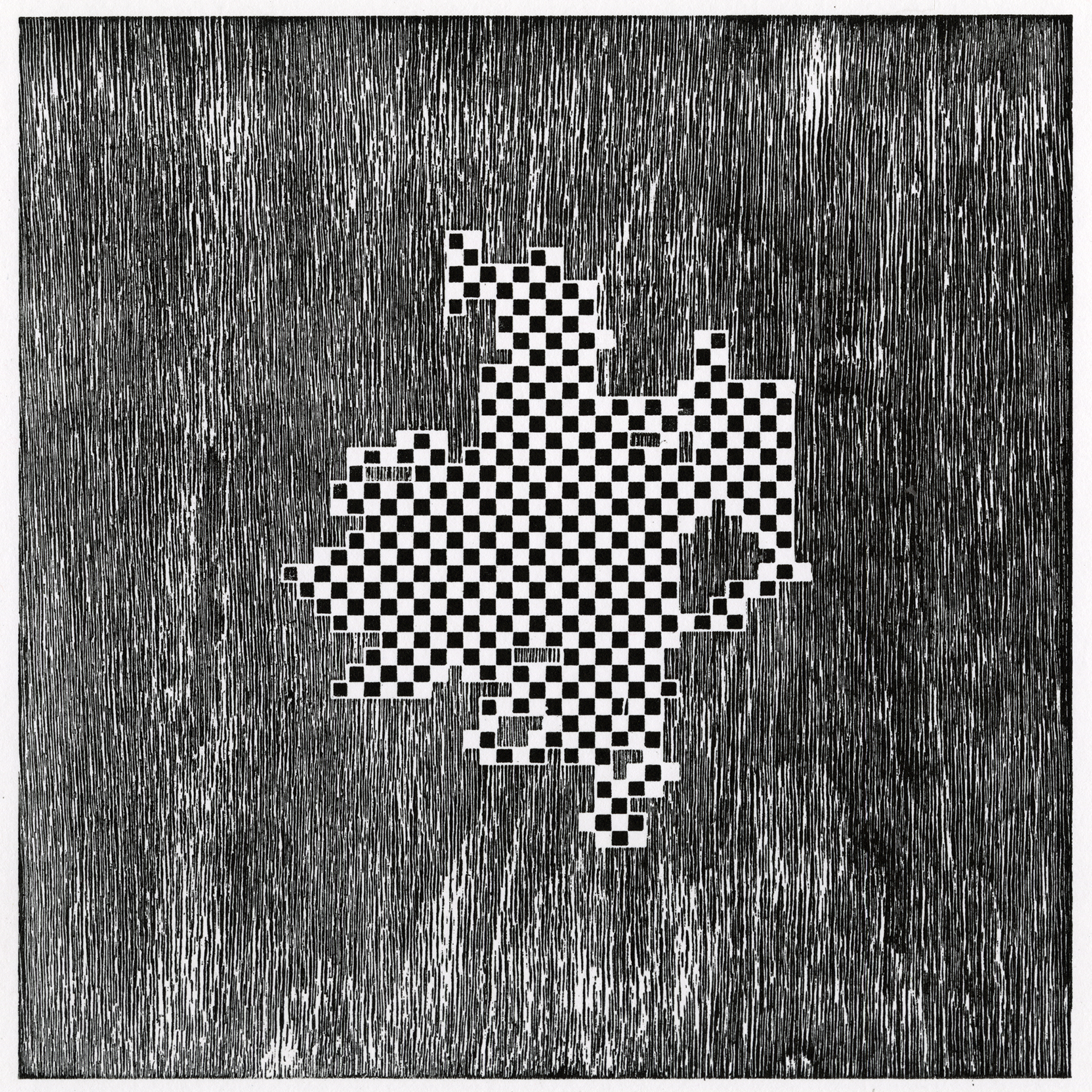
Thing 3, woodcut, 8”x8”, 2024
FOUR
Quotes:
“The Idea of the Fabrication — If a straight horizontal thread one meter long falls from a height of one meter onto a horizontal plane distorting itself as it pleases and creates a new shape of the measure of length.” — Marcel Duchamp, from The Writings of Marcel Duchamp
“The order of things is neither established, regulated, certain, nor above all definitive. The elements of this world are not linked together like the letters in handwriting by some subjective and relatively rational scheme but follow each other indifferently, juxtaposed like the kinds of type used in printing presses. It is up to the typesetter to group them in a given order and so much the better, says Duchamp, if the foreman is drunk or inattentive, or if an accident jumbles the type and mixes up the composition.” — Michel Sanouillet, from The Writings of Marcel Duchamp
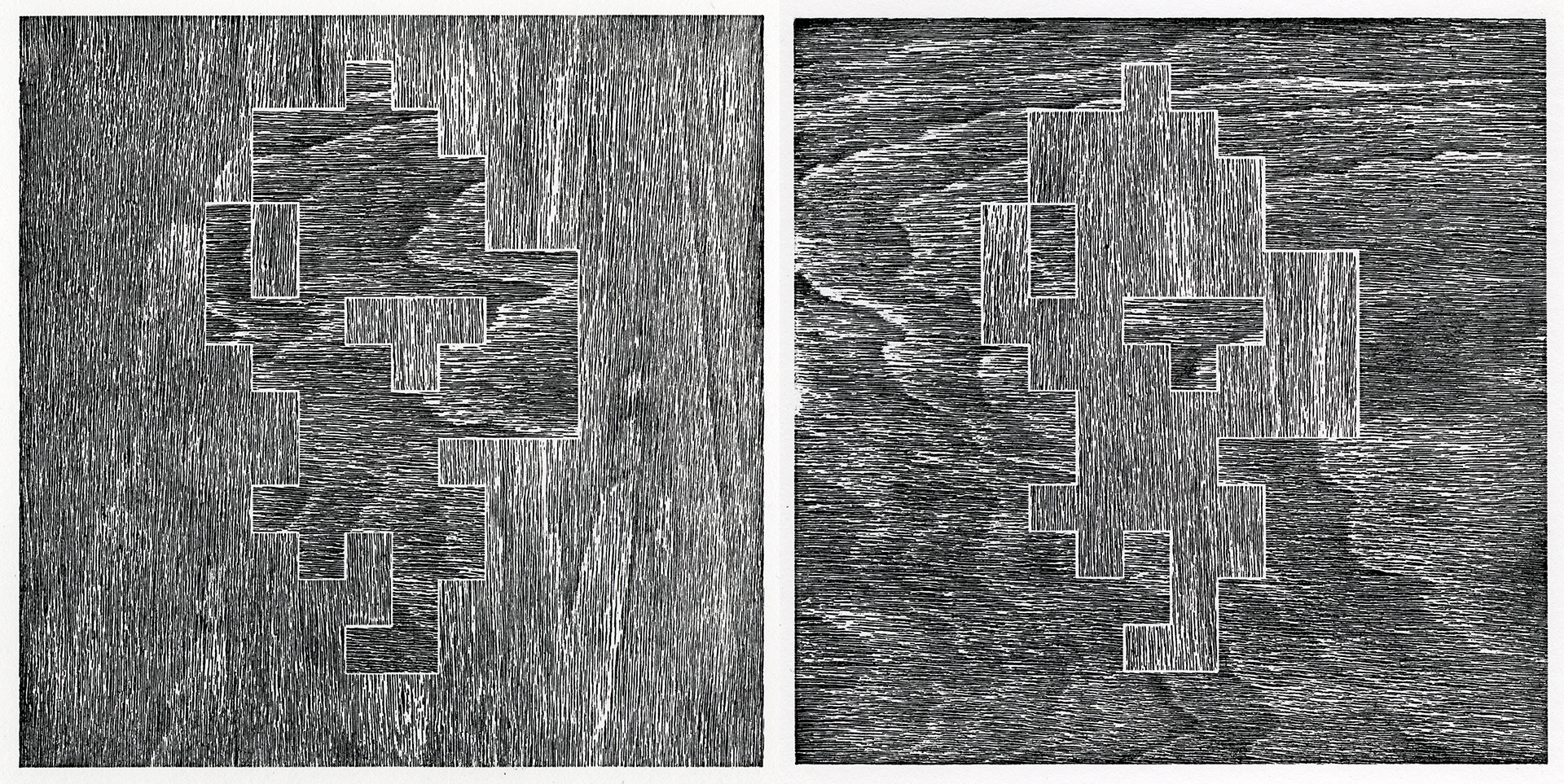
Thing 1 and Thing 2, Woodcuts, each 8”x8”, 2024
FIVE
Overused thought experiment: put a monkey in a room with a typewriter, give them an infinite amount of time, and they will eventually write Shakespeare’s Hamlet. I don’t get why this is a thought experiment, because it actually happened, and it took place in less time — about 13.8 billion years. Replace the typewriter keys with atoms and you get the same result. The random collisions and combinations of matter formed the universe and the galaxy and the stars and the solar system and the planets and the earth and the life forms and the monkeys and then the monkey called Shakespeare wrote the play called Hamlet. According to my monkey brain, emergence happens when small, dumb things follow simple rules to create big, smart things. The usual examples: ant colonies, slime molds, cities, book recommendation algorithms, consciousness, birds swarming like the smoke monster from Lost, the list goes on.
When I was learning how to code, one of the programming examples I encountered was The Game of Life. Invented by mathematician John Conway in 1970, the game consists of a grid of pixels that can be either “alive” or “dead”. Depending on the amount of “neighbors” each pixel has, a pixel stays alive, dies, or multiplies. When the program runs, depending on the initial pixel configuration you select, these simple rules create hypnotizing patterns of little squiggly spermatozoids moving, combining, dying, pulsating, oscillating, and looping. In other words, they look like natural formations and in some cases, living. Here’s a self-looping pattern that resembles the formation of a galaxy (found by Jan Kok in 1971) and translated using my hand-printed woodcuts:
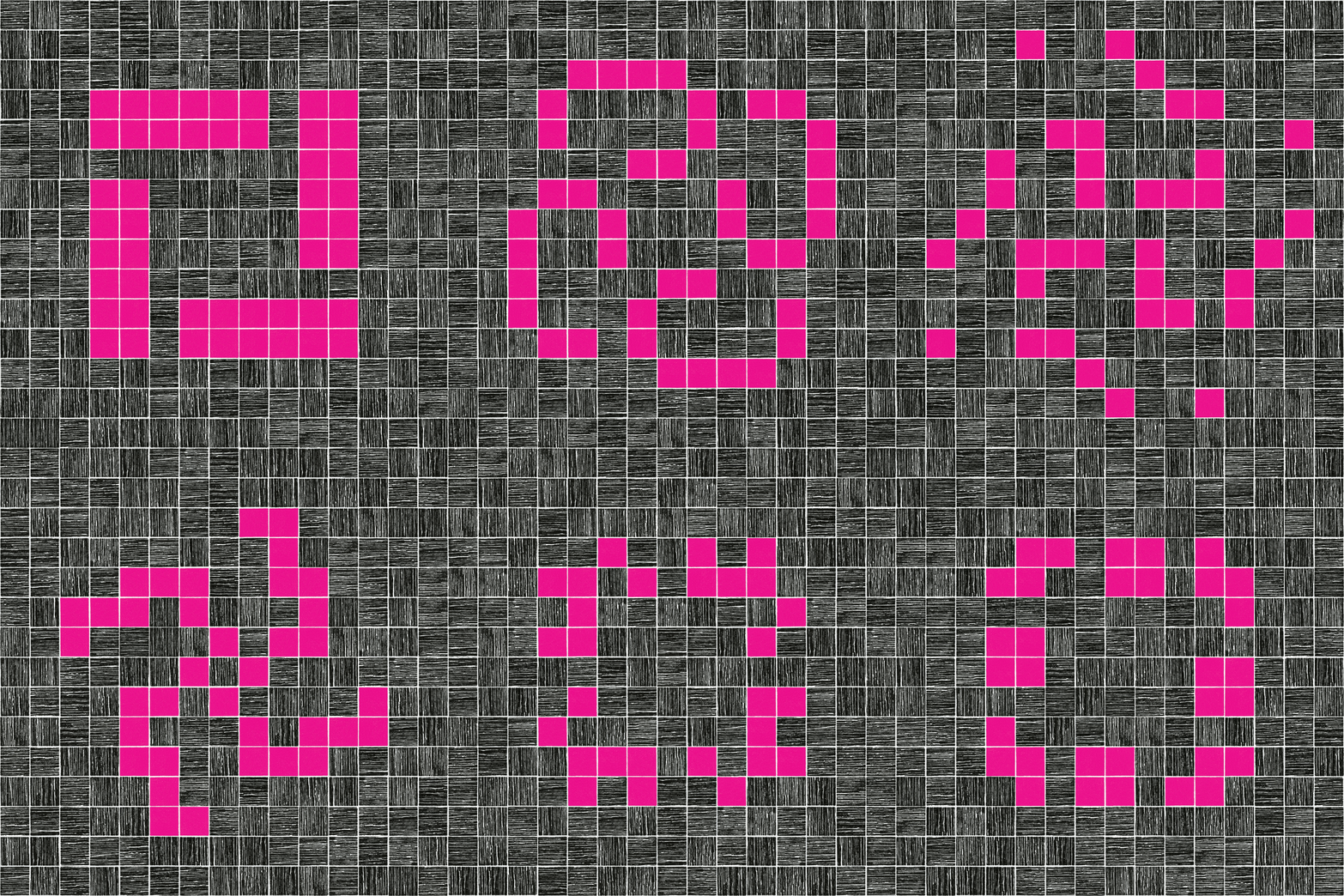
Kok’s Galaxy With Randomized Woodcuts
SIX
The Sum of Things refers to a phrase used by the Roman poet, Lucretius, in his work The Nature of Things. He expounds on the materialist philosophy of Epicurus, who proposed a unifying theory of two opposing views on the world: everything is constantly changing or everything is always the same. It centered around “atoms” — incredibly small, indivisible and unchanging units that are in ceaseless movement and collision, creating everything in the world — The Sum of Things. Combining and separating, these “particles that go from one shrinking object cause another thing to grow, making the former shrivel up, while making the latter flower, never lingering…the Sum of Things is every hour renewed.” The atoms I use in my artwork are lines, halftones, and pixels. They are the building blocks of images. Seemingly simple, these particles are elusive and paradoxically double. Zoom out to hide them and they make, construct, and build. Zoom in to reveal them and they abstract, obscure, and destroy. I like to combine and arrange them according to chance, because to use chance is to affirm the material world, the only one that matters.
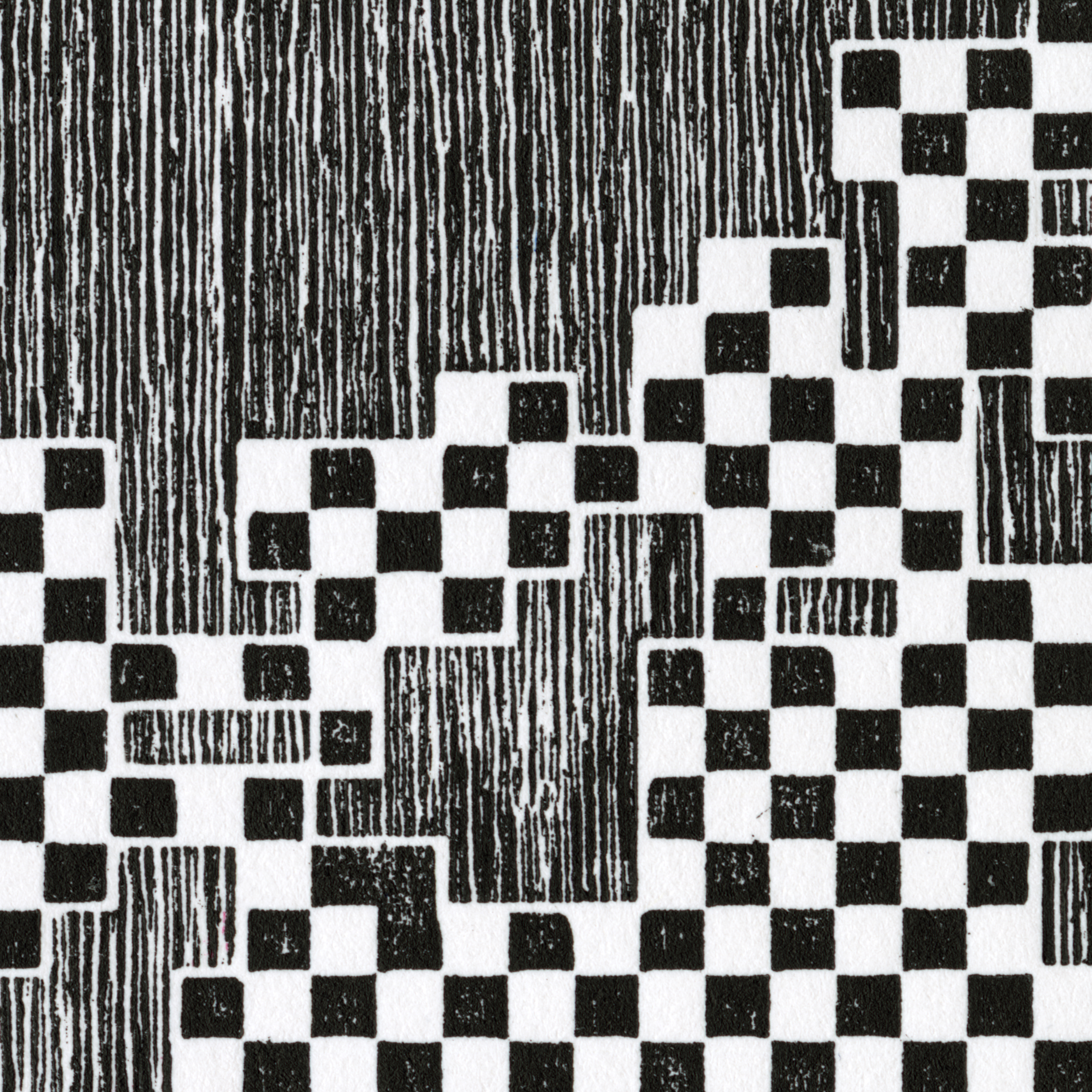
Thing 6 (detail), Woodcut, 8”x8”, 2025
Noah Matteucci is a printmaker that uses computer codes to loop loop loop instructions that are traced, arranged, carved, exposed, lasered, mapped, and/or translated onto/into a printmaking matrix like a wood block or even a block of wood. The block is inked with a brayer (which is inked with a glass slab which is inked with an ink knife which is inked with a tin can) and then it gets read a story and kissed on the forehead and tucked into bed with its little paper blankets and pushed-popped-pooped through a press creating a copy of a copy of a copy. Repeat instructions. Good morning.
He studied printmaking at UC Santa Cruz and UH Mānoa. His collaborative work has appeared at The Honolulu Museum of Art and, more recently, at Portland Community College, Sylvania (thank you Avantika!). During the day you can find him hard at work playing chess in the Art Department at WSU Vancouver and at night tinkering in a little studio located in the bowels of his house that many people would describe as a basement.