Jury Tosh Kobayashi-Mackay
“I don’t really concern myself with form. And the reason I don’t is because I know it’s there.” Cecil Taylor[1]
Cecil Taylor (1929-2018) was an incredibly enigmatic and prolific artist. Although often considered a musician and poet, in many ways he might be understood as an intermedia artist due to the scope of his work.[2] Taylor was a pianist, he composed music, performed music, danced, read and wrote poetry, worked with the Living Theatre and his artistic practice usually blended all of the above elements into one seamless performance. In this piece, I mobilize Taylor’s artist methodology generally referred to as Unit Structures to generate a music/sonic art piece (whose form is necessarily emergent), a drawing, and a poem.[3]
Over the past four years my improvised art practice has been drawing primarily on Taylor’s Unit Structure methodology. This is in part because it is the topic of my recently submitted dissertation but more importantly because of my love for Taylor’s work. Unit Structures is an extremely flexible and generative way to make improvised music and, as I will discuss below, has also helped me understand my emerging drawing practice.
As mentioned earlier, Taylor’s art practice is quite complex and often hard to describe. As a result, my description of Unit Structures will be necessarily incomplete and mainly serves to give a broad understanding and a map to the listener. Broadly conceived, Unit Structures comprises of multiple musical units (or cells) that when processed (via improvisation) create a structure, which is the given piece of music. The units, which are sometimes referred to as cells (because of the size and fecundity), comprise of a few (often) precomposed notes (for instance E, B, F) on which the player improvises. Generally speaking, the units can be played forward or backwards, musicians can add notes to the unit, take away notes, transpose the unit or use the shape of the unit as inspiration for further improvisation. It is up to the discretion of the performer how the unit is treated and, as a result, each rendition of a unit structure piece is unique. In a group context (Taylor often composed for large ensembles) the music is very complex because each musician will choose to improvise with the unit differently based on how they are feeling that day, what they hear someone else do, the way the audience is reacting, and so any given performance of Unit Structures is always new and emergent.
To return to the quote that opens this work, Taylor was not concerned with form, meaning, he did not compose music based on a preconceived established form. Instead, form is always present because the music emerges from (borrowing from Barad) the intra-action of the various ways of processing a unit. The many lines that occur, even in Taylor’s solo piano music, requires careful listening to follow and often even the hearing of his work can be different in each listening based on the ways a listener might hear the musical lines interacting.
In what follows, I present an audio recording of my own double bass performance of unit structures. The unit was composed by me, and the performance is almost entirely improvised. This is paired with a drawing I have made which is similarly inspired by Unit Structures. Finally, I end with a short poem. Taylor was a prolific poet, and after studying his work closely, I have begun writing poetry in addition to my improvised music and sound practice to develop a closer understanding of his poetics.
I have often, for lack of better term, doodled when bored. I generally take a shape (square, triangle, etc.) draw it on a corner of page and then spontaneously add shapes to cover an 8 by 11 page. The initial shape serves as a template from which all other choices are made. And while I do begin the work with an outcome in mind, the work mainly emerges as a result of the filling space with shapes. Through the course of studying Taylor for my PhD dissertation, I have begun to see my casual doodles as a form of Unit Structures on paper. I have begun to take the practice more seriously and as result my drawing practice is both emergent (I am new to drawing) and emergent in style.
I encourage listening while reading my poetry and looking at the drawing.
Unit (e)mergence
       Shattered shapes,
       shaped,
       shipped,
Spat from pen,
       inked,
              by way of hand, by way of eye
Filled space, boundaries not included,
              boundaries trespassed…
It wasn’t bounded, so much as blown
It wasn’t blown so much as heard,
          Heard, felt, struck by,
          (struck, strick, struck strick)
Heard as shapes that give rise to piece,
Piece being the name we give to music when it is perceived as a singular shape
          (a shape or structure made of many pieces)
Piece being always many shapes, many pieces.
Piece then being a merging of pieces, emerging pieces being pieces of pieces
         Pieces and Pisces and Pieces and Pisces
(Slipped through Serpentinian shapes/equations not withstanding)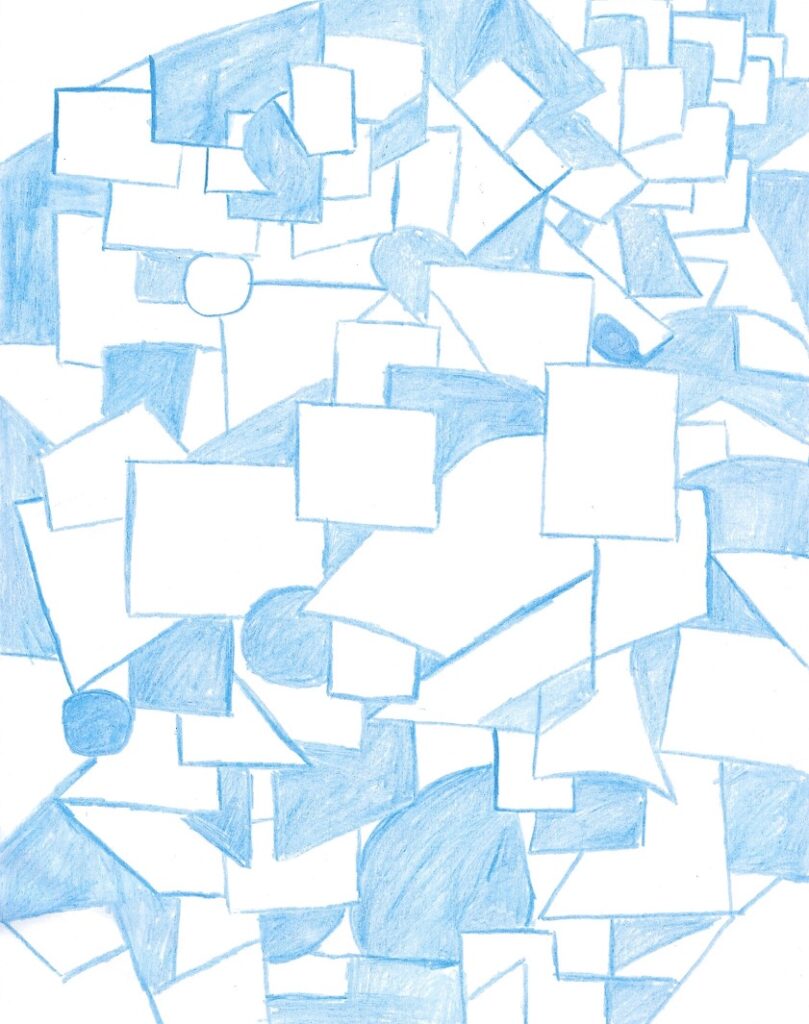
Jury Kobayashi-Mackay is a multidisciplinary artist and scholar. He primarily improvises with his double bass and mobilizes creative writing (inspired by his academic research) often in the form of poetry. He is currently completing an interdisciplinary doctorate at the University of Ottawa with a dissertation on the poetics of Cecil Taylor’s music. His compositions have been featured on BBC radio and have been played on independent radio stations in Ontario and Quebec. Outside of his art practice and scholarship, Jury writes album reviews with the FreeJazzBlog and teaches double bass.
Works Cited
Barad, Karen. Meeting the Universe Halfway: Quantum Physics and the Entanglement of Matter
and Meaning. Durham: Duke University Press, 2006.
Freeman, Philip. In the Brewing Luminous: The Life and Music of Cecil Taylor. Hofheim: Wolke
Verlag, 2024.
Funkhouser, Chris. “being matter ignited… an interview with Cecil Taylor” edited by Nathaniel
Mackey. Hambone No. 12. (1994).
Morris, Joe. Perpetual Frontier: The Properties of Free Music. Stony Creek: Riti Publishing,
2012.
Spellman, A.B. Four Lives in the Bebop Business. New York: Fourth Limelight Edition: 1994.
[1] “being matter ignited…” interview with Cecil Taylor by Chris Funkhouser. Hambone, No. 12, edited by Nathaniel Mackey, 1994.
[2] For a detailed biography, please see Philip Freeman’s In the Brewing Luminous: The Life and Music of Cecil Taylor, Hofheim: Wolke Verlag, 2024 or the classic A.B. Spellman Four Lives in the Bebop Business. New York: Fourth Light Limelight Edition, 1994.
[3] I draw my understanding of how to improvise using Unit Structures as a methodology from my own analysis of Taylor’s music and from Joe Morris’s detailed descriptions of Unit Structures in Perpetual Frontier: The Properties of Free Music. Stony Creek: Riti Publishing, 2012.