Jack Kramer
Walking through Waiheke Island based sculptor Denis O’Connor’s exhibition at Two Rooms gallery, Lucken’s Alphabet, you get the impression you are browsing the artist’s mind. Each slate on the row arranged on the gallery’s upstairs wall hosts a letter, which corresponds to a word, an image, and a text— associated elements that seem to float around O’Connor, each bringing the viewer closer to knowing him. Lucken’s Alphabet is the final installment of a trilogy of exhibitions that have appeared around Auckland each summer for three years. The three exhibitions— Lucken’s Margins, Lucken’s Wings and Lucken’s Alphabet— share a word which O’Connor has taken from Gaelic poetry, a Celtic word meaning drawn together. In these three exhibitions the word is personified into a character: Mister Lucken, an artistic spirit who embodies the essence of connection and reconciliation.
The Lucken trilogy appropriately follows a career in art that O’Connor has spent “honouring things that don’t get acknowledged.”1 The artist, who lives on Waiheke island, has devoted many of his projects, such as The Tangler Chapter 2 in 2011 or The Archive Wine Bar in 2015, to appreciating the culture of the area. O’Connor told the New Zealand Herald in 2022 that he is committed to these anonymous or unrecorded people who have “assumed positions in the culture.”2
The previous two exhibitions in the Lucken trilogy can be seen as vessels through which O’Connor paid homage to significant figures in his career as an artist. Throughout the first Lucken exhibit, Lucken’s Margins, which is composed mainly of carved slates similar to the ones used in Lucken’s Alphabet, O’Connor celebrates plain, everyday objects as talismans of personal narratives. This exhibition also honours the importance of found objects to artists, and artistic communities. “The Two Lost Fingers of Koie Ryoji,” for instance, which sat at the end of the long hall where the exhibition was presented, consists of three objects along a wooden board: a stack of 10 mountain-tea-bowls, all fused together, from the Heian dynasty, given to the artist by artwork’s namesake, a blackened piece of wood, and a small ceramic platter. This piece honors the artist Koie Ryoji, who hosted O’Connor during his residency in Japan. This exhibition focused on a key element of Mister Lucken’s talents, who, much like O’Connor, is “attuned to the margin,”3 and adept at recognizing and connecting something that might not be well recognized. Through this dedicated, deliberate focus, he elevates the significance of found objects produced by networks of artists sharing things. Appropriately with the theme of artist community, the exhibition features a collaboration with artist Kate Newby.
Lucken’s Wing, which was unveiled on Waiheke Island the following year, is a public art piece— O’Connor’s bread and butter: a vintage Harley Pocket-Rocket bicycle mounted on a four meter model of a pencil, pointed up like a ramp. The piece, like Lucken’s Margins, allows O’Connor to pay tribute to his unrecognized heroes; here, he commemorates the culture of amateur
motorcycling on Waiheke Island. These anonymous engineers share with O’Connor an appreciation for found objects, for the unacknowledged item that holds an emergent power— whether that be in fixing a motorcycle or representing a narrative. Mister Lucken’s influence is present in this piece in the union (or Luckening) of two identities that may seem in opposition in a single artwork: the amateur motorcyclist and the artist.
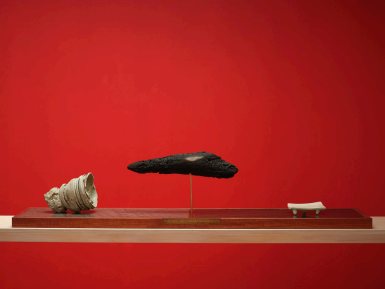
The Two Lost Fingers of Koie Ryoji, 2023 (345 x 1555 x 350 mm)
In Lucken’s Alphabet, O’Connor upsets the model that has motivated a career of paying homage. Through a series of tablets drawing out a network of connections between loved ones, mentors, meaningful texts and songs, and found objects, the artist honors himself. Using the same mode of artmaking as the other exhibitions, he elevates himself to the focus of Mister Lucken. On the back of each slate, O’Connor scrawls a quote and its origin, his name, the date and sometimes another hint to string all these things together, a note on his personal relationship to the object depicted in the slate or the quote on the back, or what he was when he made the piece.
On the backside of M for Maunga, he quotes a line from a poem by his “old friend” Bob Orr, then includes in parentheses that he made the cover for AUP’s 2008 edition of the book. Similarly, in several other letters like A or R, O’Connor ties himself to the quote by citing his own work, or an otherwise related association like in J for Jargon, where a Ciaron Carson quote is taken from a book whose copy O’Connor got signed. The images on the fronts of the slate too, often feature appearances from the found objects that have followed O’Connor all throughout his career: the radiola in O for Operetta from his time in Champagne as a Möet & Chandon Art Fellow, the chair in C for Culbert which the artist writes, “evokes artist Bill Culbert’s seating arrangements around his beloved sanctuary in the Luberon village of Coragne.”
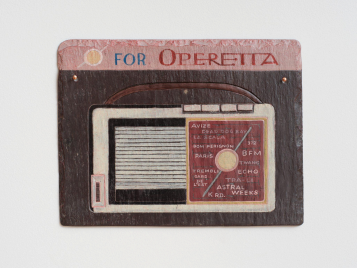
O for Operetta, 2024 carved, pigment, wax on Welsh slate (200 x 250 mm)
On several occasions, O’Connor even tracks himself down to the moment of creation. He dates C for Culbert to when he “stayed with Bill & Pip Culbert in Croagnes, Luberon, France,” and D for Doorness after “after travelling to Porte de Sevres, PARIS, National Ceramics Museum and it was closed.” In the latter example, the parenthetical seems to directly correspond with the title. Indeed, the text, “he showed me the place LA PUERTA, he said DOOR… there was nothing there,” which comes from Hill of Doors by Robin Robertson, aligns nicely with the subject matter. However, this letter-word-text dynamic is muddled by the image on the slate. Above the title text, there is a split backdrop of blue and black behind a bird flying into the letter D, which opens up at its corner like a mouth with two pink lips to receive the bird; below them a pole hovers in the center of the background with two balls like spinning tops on either end. The image lacks the simple relationship that connects the other aspects of the piece— does the mouth of the D represent a door, or the flying bird O’Connor locked out of the National Ceramics Museum? The divided background, the dichotomy between open and closed? O’Connor makes sure to never allow a single slate to present one simple meaning.
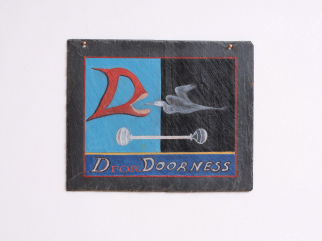
D for Doorness, 2024 pigment on Welsh slate (200 x 250 mm)
O’Connor has spent a career drawing out the juice from found objects in order to honor those whom they belong to, but in this exhibition his tribute to friends and family feels more like a self portrait of the artist. While Lucken’s Margins functions in a similar way, the artist is less present in each piece; he detaches himself from the artwork to honor the object and the life it represents. However in Lucken’s Alphabet, it is impossible to ignore O’Connor’s entanglement with each image, quote and story. The backsides of each tablet, although hidden from view when initially viewing the exhibition, change the viewer’s experience completely once revealed in the gallery’s pamphlet: they produce a new, emergent understanding of each slate representing a different aspect of the artist’s career and life. This process of viewing also mirrors the way O’Connor describes his own work, with things like “talismans and coastal rituals” slowly forcing “their way into [his] claywork and [providing] a sort of heraldic alphabet for [him] to draw on.”4
The material of the slates themselves advance a viewing of Lucken’s Alphabet as a self portrait. O’Connor has cared deeply throughout his career about the provenance of his materials, and his ability to transform things like junkyard limestone into valuable mediums. Here, the slates tell the story of O’Connor’s life and the history of his family’s migration— a theme that has been significant in his work for decades. Many slates came from heritage buildings in Auckland; all the green slates came from Saint Patrick’s Cathedral, where his parents were married, and he was christened, and almost half are Welsh slates, having made the same migratory passage that O’Connor’s father did. He writes that these plates “from the Northern Hemisphere… are the material cargo evidence of the diaspora.” The slates as a whole, much like O’Connor, are a transnational blend of Irish and Kiwi, themselves Luckened objects.
This web of associations that the slates form, between their provenance and substance resembles the same nebulous relationship between letter, word and image that serves as the foundation for the exhibition. O’Connor writes, “image is not ‘defined’ by the word, it’s linked by something more suggestive or mysterious.”5 His intention in Lucken’s Alphabet is for the viewer to puzzle over the shapeshifting Mister Lucken’s design, and to be beguiled by the “force-field of associations” he creates. Much like the true connection between word and image isn’t designed to be defined, so much as it is to be pondered upon, O’Connor’s identity is concealed within the exhibition like a series of clues without a solution. Who can say exactly what role the antler-horn dice from the National Museum of Ireland in K for Known, or his mother’s sowing in H for Hat, or the Joni Mitchell lyric on the back of V IV Vinyl played in O’Connors life, or how it affected him.
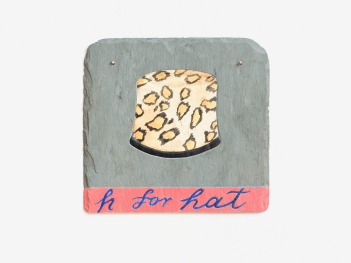
H for Hat, 2025 carved, pigment on Catskill Mountain slate 240 x 255 mm
The Lucken trilogy is not O’Connor’s first undertaking with the conceptual problem of associations, or entanglements. One of his first exhibitions at Two Rooms Gallery was also a trilogy which came in the form of three “chapters” of the character The Tangler. O’Connor writes the role of the Tangler, born out of his fascination with Irish tradition, is to “arbitrate, broker, and find common ground.”6 The Tangler shares some substantial characteristics with Mister Lucken— they are two personified elements of mythology whom O’Connor has employed to perform the duty of reconciliation. O’Connor himself, whose career as an artist revolves partly around his own two identities as Irish and Kiwi, can easily slip into either of these characters.
Mister Lucken and The Tangler are characters through which O’Connor can enact mediation, what he sees at the job of the artist. These personas, rooted in Gaelic tradition, allow the artist a position from which he can examine found objects from a bit of distance. In this way, he is also performing the act of Tangling or Luckening with himself and the mythical artist persona. Lucken’s Alphabet, appropriately culminating the Lucken trilogy, embodies the central concept of mediation in every element of the exhibition. But as the parties he attempted to reconcile— namely word and image— are never quite fully commensurate, O’Connor’s responsibility is never completely fulfilled. In Lucken’s Alphabet, he celebrates the fallibility of language, rather than trying to fix it. What develops in the space between these elements is emergence, a viewing that seeks to understand a final product that never matches up perfectly.
Jack Kramer is a junior at the University of Pennsylvania, studying English and Urban Studies. He worked at the University of Auckland as a guest editor on Drain Magazine this winter, where he was able to explore local Auckland art. Jack is from Brooklyn, NY and recently got his driver’s license.
1 Frances, Helen. “Sarjeant Happenings: An artist’s homage to artists,” NZ Herald, 2022.
2 ibid
3 O’Connor, Denis. “Lucken’s Alphabet,” Two Rooms, 2025.
4 O’Connor, Denis. Songs of the Gulf, Auckland City Art Gallery, 1984.
5 O’Connor, Denis. “Lucken’s Alphabet,” Two Rooms, 2025.
6“The Tangler,” Two Rooms, 2008.