Montserrat Sobral Dorado
This paper explores aesthetic experience as an adaptive dynamic system through the lens of fractal logic. Moving beyond the traditional subject-object dichotomy, it proposes a situated and emergent understanding of aesthetics that incorporates production, reception, and transformation over time. Using Rudolf Kaehr’s Diamond Theory as a conceptual framework of fractality, the study models aesthetic relationships—poiesis, apate, mimesis, and catharsis—as iterative, interconnected patterns. The Homeric Odyssey is analysed as a case study to illustrate how aesthetic meaning emerges fractally across historical and cultural contexts. This approach provides a non-linear logic for understanding the evolving intraactions between sensibility, art, and culture, demonstrating the enduring and adaptive nature of aesthetic systems.
Introduction
Our aesthetic experiences have been reflected, described and understood in different manners throughout history. In the long term, the common denominator of all is art in its role as a mediator. A work of art can generate a network of relationships that range from artistic elaboration to reception. This network of relationships is not simple but rather complex, so its study cannot be reduced to subject-object relations but must consider the interweaving of sensitivity, art and culture. In fact, the word “complex” comes etymologically from the Latin plectere, which means “to fold”, “to intertwine”. It refers to the quality of something folded repeatedly. It suggests that all components of an aesthetic experience are dynamically interconnected in complex patterns, taking into account other previous aesthetic experiences.
As Donna Haraway explains in Staying with the Trouble, each of us is like the knots of a complex system, connected through intraactive relationships (2016, p. 60). This aesthetic system, composed of the network of relationships woven between sensibility, art and culture, implies a co-creation, a constitutive interdependence between the system and its environment. For this reason, its dynamics permeate multiple aspects of our lives without the need to be reduced to one of them.
From this perspective, the present paper approaches aesthetic experience through the conceptual tools of the sciences of complexity, following the path delineated by other philosophers such as Jordi Claramonte, Eduardo Maldonado, and Denise Namajnovich, among others. Consequently, its analysis will necessitate a relational and complex perspective, eschewing reduction to the artistic reception or the aesthetic object. This paper proposes a dynamic conception of aesthetics as a situated, sensitive, and emergent practice involving production, reception, and transformation.
Aesthetics as an adaptive dynamic system must incorporate the interconnected parts of the system and the nature of the connections that are effectively maintained over time through sensitivity, art and culture. This requires a consideration of the processes involved and the contexts in which they are performed (Claramonte 2016, p. 121; Gell-Mann 1995, p. 24; Maldonado 2021, pp. 16, 21).
Therefore, this study could not be constrained by a dualistic interpretation of the link between art and subject, nor for a cause-effect analysis, as would be the case of theories of aesthetic interaction. Instead of focusing on the viewer’s response to the artwork, the Diamond Theory provides a framework for understanding how the relationships among different aesthetic experiences intra-act on a particular aesthetic experience resulting in the emergence of the work of art.
Moreover, it does not address the dynamics of the system with its environment in its operational closure, as this would reduce the analysis to the functionality of art in some of the spheres of society. Instead, it provides a tool, diamonds, for thinking about the relationships in the aesthetic system and its context. Therefore, it is important to consider how the arts serve as elements that connect us through history and affect us in various ways. Additionally, it is crucial to acknowledge the reciprocal influence between the context and the arts. We, as part of a culture, have a role in shaping the arts, whether by reusing, transforming, or even forgetting them.
Accordingly, the objective of this study is to trace the expression of a fractal through the Diamond Theory that describes the complexity of aesthetic behaviour over time. The diamond logic will be used as a conceptual tool for thinking our aesthetic experiences as iterative relational patterns, without any claim to interpretative closure or deterministic formalization. Developed by Rudolf Kaehr in his 2017 publication The Book of Diamonds, this model utilizes fractal and non-linear logic to depict relational structures. When applied to the reflection of the complexity in our aesthetic experiences, this theoretical framework will help us to understand the constitutive interdependence between the aesthetic relationships and their context.
In contrast to other studies of fractality in art, such as those by Kocić & Ljubiša (2002), this article does not carry out a formal analysis of artworks but rather proposes an aesthetic system and examines the characteristic and recurrent elements within it. This will allow us to show the inherent complexity of aesthetic dynamics over time and to map the cultural territory where our sensibility develops and elaborates an aesthetic object. It is not a matter of providing a mathematical model in the strict sense that encompasses the totality of our aesthetic experiences throughout the history of art, but of contributing to its reflection from artistically mediated interactions and in relation to the world (Claramonte 2021, pp. 27, 261-6; Maldonado 2021, pp. 168, 170; Namajnovich 2005, pp. 33, 39). This involves understanding the dynamics of these interactions and how they are captured through Rudolf Kaehr’s diamonds.
We will begin this article by specifying what the relationships and parts are that intervene in an aesthetic experience to understand how they behave as a complex system, specifically an adaptive dynamic system, over time. Then we will see what fractals are and how they apply to the fractal behaviour of Rudolf Kaehr’s diamonds. Finally, our experience with the Homeric Odyssey will serve as a practical application of this theoretical approach.
Aesthetic experience as a dynamic process linked to time
This work is based not only on a notion of aesthetics that corresponds to the reflection on art, but rather on the study that must deal with the nexus between artistic practice, sensibility and culture. Therefore, the discipline of aesthetics will note how our sensitive perception leads to an artistic behaviour that gives rise to practices that, once poured into society, collect and shape its cultural values (Claramonte 2016, p. 121).
To understand the relevance of art as a mediator of our relations in the whole of humanity, it is appropriate to extend our attention to the work of art. In this way, its analysis will allow me to understand its characteristics and aesthetic qualities, as well as the relationships that motivate my perception of its characteristics and qualities. Art as a mediator between our relationships involves a study of the work in relation to us, but also the nature of relationships that converge in it. Likewise, I will have to consider the context in which this aesthetic experience takes place and the different processes that interact in these relationships and their context (Bishop 2022, p.254; Juarrero 2023, pp.40, 235).
From this perspective, an aesthetic experience proceeds from a previous set of aesthetic relations and promotes the emergence of new ones. In other words, the arts sustain and produce sensibilities, but aesthetic sensibilities also promote the production of works that take into account both their respective specificities and new explorations (Claramonte 2016, p.133; Hartmann 1977, pp.163-167).
The Odyssey, for instance, played a significant role in the lives of the ancient Greeks. From the VIII B.C.E. century onward, Homeric works have remained indisputable references about the aristocratic world and of human conflicts, even as books became an integral part of this civilization’s cultural repertoire. The protagonist of the Odyssey exudes such modernity that it has served as a source of inspiration for artists, including those who are historically distant from Homer, such as Joyce.
Ulysses symbolizes travel, adventure, return, tenacity and trickery, as well as human imperfection and the journey back home, among other things. This Homeric character may be representative of a historical moment, that of the heroic era in Greece, but above all he is an archetype of the human condition (Nicolson 2015, p. 71, 219; Vallejo 2019, p. 91). For this reason, the work has connected with the different sensitivities of humanity in each time period, through different forms of representation ––oral, literary, dramatic, comic, etc.––, accommodating the diverse values that each historical moment entails. Additionally, his story has provided a valuable source of inspiration and a framework for reflecting on the human condition.
What is related in our aesthetic experiences
Reducing the notion of aesthetic experience to the act of reception, to the contemplation of an artwork, would also reduce its temporal continuity to a specific historical moment. In this paper we will propose aesthetic experience as a complex process with multiple layers, beginning with the one who produces the artwork and continues with the one who receives, reinterprets and transforms it: a set of relationships that, mediated by the work of art and for a specific experience, go from its elaboration to its reception without ending in it, because, as we have seen, it is capable of nurturing new aesthetic relationships.
Our aesthetic experience therefore begins with the act of producing a work of art. Taking into account the role of the artist, we will be able to recognize the historical context in which the work has materialised, and the particularities contributed by the artist, if we know his authorship. Likewise, considering the act of artistic production, we will pay attention to the set of relationships that intervene in the work during the historical period between elaboration and reception. In this way, we will be able to appreciate the various interventions in the work’s content, such as restorations or translations and editions in the case of literary works.
In addition to the material qualities of the work presented to the senses, the inclusion of the productive act in the whole of our aesthetic experience takes into account other aspects that we co-perceive, such as the social context in which it was produced, its commercial value, its cultural recognition, etc. (Hartmann 1977, p.65; Najmanovich 2005, p.24). In this sense, we can understand the relationship ––or set of relationships–– between the act of production and the work of art as the formation of a complex organized over time, which does not behave as an object that is repeated over time, but rather brings novelty precisely because of its recurrence in history (Hartmann 1964, pp.39-41; Najmanovich 2005, p.29).
Nicolai Hartmann explains the behaviour of the work of art through the acts of production and reception. According to this philosopher, it is ontologically composed of two main layers: a material one, which carries its structure; and an immaterial one, which explains its way of being. This describes the material nature of art, which we perceive sensorially, and the spiritual nature, which holds its aesthetic values and forms a bridge between the artistic elaboration and its perception.
On the one hand, Hartmann asserts that ‘in all regions of objects, matter co-determines form’ (Hartmann 1977, p. 20) while ‘the spiritual content carried by conformed matter always needs the opposite performance of the living spirit, both personal and objective; for it is destined for a contemplative consciousness’ (Hartmann 1977, p.100). This allows us to understand that the work of art is not a simple entity but rather hosts the transformations due to its mediating role in the set of relations that make up the aesthetic experience. The dynamics of this process involves the emergence of the content inscribed in art, its extensive capacity to communicate from sensibility and intersubjectivity, hosting new contributions of meaning and opening to different possibilities that are difficult to foresee (Maldonado 2021, p.138).
Thus, the set of relationships we have seen could be schematised as follows:
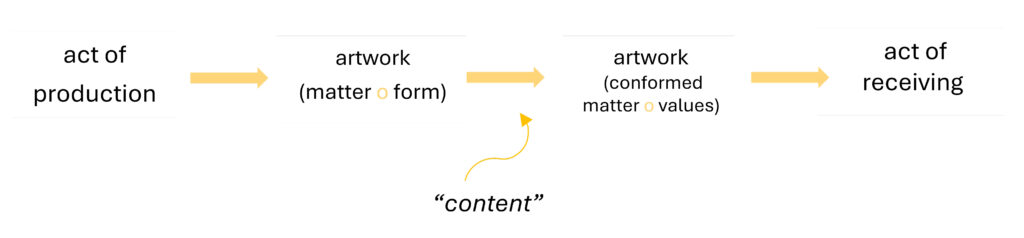
The expressions in brackets ‘matter o form’ and ‘conformed matter o values’ refer to the nature of the work of art according to Nicolai Hartmann, i.e. the composition of matter and form and the composition of matter conformed with values. The content appears in the work for reception, linking the sensitive objectual nature, as matter with form, with its behaviour in our aesthetic perception, as matter conformed to values (1977, p.100).
Aesthetic categories for our relations
So far, we have described the parts or relata involved in a particular aesthetic experience ––the act of production, the act of reception and the work of art–– and we have emphasised the fact that both the narrative and other external factors influence this aesthetic experience, which explains why a work of art cannot be reduced to a single meaning and shows the ability to continue to present new values over time.
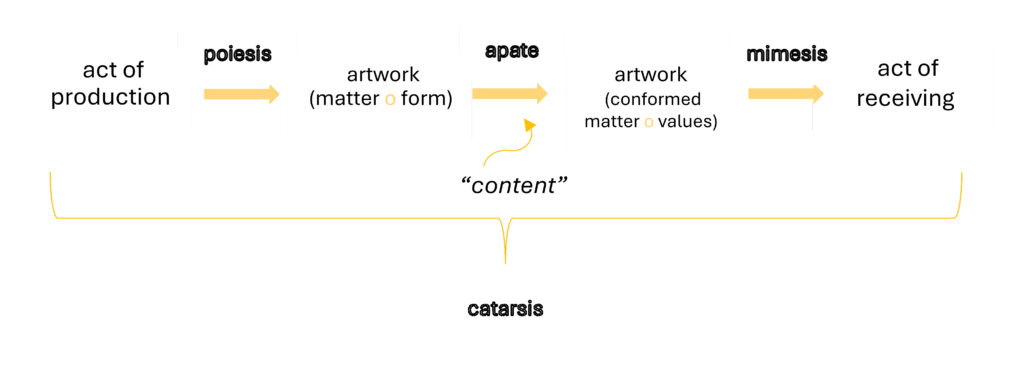
To describe the relationships that link these parts, we will apply the categories used by Jordi Claramonte in the second volume of his Modal Aesthetics: poiesis, apate, mimesis and catharsis (2021). Following Aristotle, Claramonte considers poiesis as the aesthetic activity of taking known elements and creating something new. Mimesis is the process of imitation that characterises reception, which, in perceiving something, identifies the other. Mimesis explores receptivity but is open to poiesis, to new elaborations that account for a specific sensibility (2021, p.171). Poetic elaborations connect us: those who produce the work provoke changes in a recognisable, mimetic structure, in a different way for those who receive it. On the other hand, the binding capacity of mimesis is manifested in the elements that allow us to connect with a work, to re-recognize its structure. Otherwise, we are confronted with an unrelatable object, aesthetically ineffective.
For its part, apate comes from the Greek verb ‘apateô’ (to deceive) and alludes to the ability of something or someone to create an illusion, a kind of trompe l’oeil with sufficient illusory power to activate the reception of the recipient and to make it enter into the game of poetic creation (Claramonte 2021, p.207). Gorgias is the first to use this term for the theatre, because in tragedy, unlike history, the spectator accepts the appearance of the facts and allows himself to be deceived. Over time it is applied to other arts (Tatarkiewicz 2016, pp.134-135).
Finally, catharsis was used by pre-Socratic authors to allude to clear discourses, to people or works that provide clear knowledge about what they are dealing with. For Aristotle, catharsis is the outcome of a process, be it formal, emotional, or conceptual. That is, this category would link our aesthetic reception to the structural totality of the work, as it relates us to the effect it has on us, due to its qualities as well as what it evokes in each of the people who receive it and what it says about the cultural context in which the aesthetic experience takes place (Claramonte 2021, pp.225-7).
Given these categories from which to think about the relationships within our aesthetic experience, the previous schema of it could be reconfigured in this way:
Adaptive Dynamic Systems
Adaptive dynamical systems are those complex systems that, while exhibiting small-scale differences, are characterized by being composed of a long network of components that, in the absence of any central control and with simple operating rules, exhibit non-trivial emergent and self-organizing behaviours. In such a dynamic system, adaptation plays a fundamental role and is involved in processes as diverse as the origin of life, the evolution of human societies, the dynamics of ecosystems or investment in financial markets (Mitchell 2009, pp.12-13).
Our relationship with the arts can be seen as an adaptive dynamic system. The parties involved in the production and reception of beauty ––or the degree of it–– are not controlled by a central power that determines what beauty is throughout history, although there are obviously aspects that can influence this consideration such as the art market, fashion, kitsch, etc. Furthermore, the members of an aesthetic experience do not necessarily interact at the same time, and their different political and socio-cultural contexts may vary in a non-linear way. The aesthetic values of a work of art appear in the aesthetic experience and can influence the set of cultural values of the system by causing emergences, that is, changes in its overall behaviour (Kocić & Ljubiša 2019, pp.193-4).
In any culture, both traditional and innovative, the values circulating through the arts, the materials used in the elaborations, etc. are aspects that evolve from the interactions between the parts that make up that culture and the context by which they are influenced, without a central control that determines them, causing changes at the macroscopic level. Describing and predicting this type of systems is done by the theory of dynamical systems. Among other things, it uses mathematical models or formulas to describe the behaviour that characterises a particular system. The attractor is the characteristic final behaviour. It represents the values to which the system eventually returning (Gell-Mann 1995, pp.36, 283; Juarrero 2010, p. 261, 2023 pp.50, 100; Mitchell 2009, p.25).
The Odyssey is a good paradigm of this. This myth has been part of our cultural system since the eighth century B.C. What’s more, its effectiveness is demonstrated by the fact that it is considered a classic, and by the fact that we continue to tell its story, we continue to translate it, to criticise it, to reinvent it. In its influence on poetry and narrative not only allows us to distinguish the structure between simple and complex fables, as Aristotle warned in his Poetics (2010, p.162), but also addresses philosophical themes, such as metis, areté, nostos, travel and search, and the creation of archetypal characters.
As a myth, the Odyssey has no specific authorship; although it is popularly attributed to Homer, the ‘Homeric question’ is still debated. What is agreed upon is that the story it tells has been shaped based on transmission and memory (Lane Fox 2024, pp.209-216; Nicolson 2014, p.47; Vernant 2002, p.VIII). The Homeric verses are inspired by the muse Mnemosyne and are written much later. The Odyssey links our past with our present. This temporal transmission will carry the material for new poetic elaborations, its reception will provoke new episodes and different perspectives, demonstrating that art emerges from myth and, in this emergence, keeps it alive, contributing to the cultural complexity and effectiveness of the system.
Diamonds as a measure of the complexity of our aesthetic experience.
The fractal is a kind of attractor
In the previous chapter, we defined attractors as the patterns of behaviour that characterize a complex adaptive system. These patterns enable us to describe the regularities of the system, despite the large number of fluctuations of the parts among themselves and with the environment. In addition, we have specified that the field of aesthetics is the set of relationships established on the basis of our sensibility, mediated by art and developed based on a culture. This set is a complex adaptive system.
Our aesthetic experiences behave like an attractor, organized around the relationships of poiesis, apate, mimesis and catharsis. In this chapter, we will see what kind of attractor these relationships form, and we will use Rudolf Kaehr’s diamond theory to analyse our aesthetic experience of the Odyssey, delving into each of the relationships through the composition of a new diamond, that is, the diamondisation (Kaehr 2017, p.145).
Fractals are a special type of attractor characterized by self-similarity at different scales. This fractal behaviour helps illustrate how aesthetic relationships repeat and evolve over time, supporting our analysis of the Odyssey. Fractal geometry is an extension of classical geometry. It can be used to create accurate models of physical structures, from ferns to galaxies. Since its inception, it has been used to explain natural phenomena with fractal behaviour, in other words, those that use a recursive way of operating.
The term ‘fractal’ comes from the Latin fractus, meaning fractured or broken. It was coined by the mathematician Benoît Mandelbrot in the late 1970s to refer to objects with a fractional dimension, lying between the dimensions described by natural numbers in classical science (Barnsley 1993, pp.1, 5, 81; Mitchell 2009, pp.103-9). In the process of fracturing an object of a given dimension, there is a variation in the size of that object. In this sense, the object of study in question presents characteristics that make it an ideal material for research in the field of aesthetics, due to its ability to incorporate the ontological and political factors inherent in aesthetic experience. These factors include the elements inherent in the experience itself and in the context in which it develops, thus providing a perspective that encompasses both the variations inherent in aesthetic experience and the implications that it entails, in the emergence of which all art is a container.
In history, thinking about time lead us to a chronological, linear dimension of events ordered by date. In the field of aesthetics, however, it is interesting to consider other aspects of time without reducing it to linearity. Understanding time through the ways in which we relate to it ontologically and aesthetically allow us to approach the complexity of our being in the world and to recognize what Nicolai Hartmann calls the spirit of the object: ‘Objectification consists essentially in the creation of a durable real product in which spiritual content can appear. Thus, the aesthetic object, insofar as it is made by man, is introduced into a wider circle of phenomena; it constitutes a special type of objectified spirit. It is completely subject to the law of objectification’ (1977, p. 100). Hartmann then refers to the effective aspect that persists in the object of the epoch(s) from the time of its production until we receive it.
The purpose of this article is not to provide an explanatory tool that encompasses the totality of art throughout history, to predict the shaping of works of art in the future or to give a numerical dimension of any specific aesthetic experience. The object of analysis here is a tool that treats aesthetic experience as a phenomenon of complexity, organized by a considerable number of factors that interact in an organic whole. As we will see below, we will consider the fractality provided by Rudolf Kaehr’s diamonds to describe and reflect on the complexity of our aesthetic experience, using a model that can be repeated in aesthetic processes.
Rudolf Kaehr’s diamond is a fractal.
Rudolf Kaehr’s Book of Diamonds (2017) provides a non-linear logic that exhibits fractal behaviour, allowing the specificity of each aesthetic experience to be discerned. In this way, we will be able to deepen each of the relationships by creating a new diamond, that is, the diamond’ inside the diamond (Kaehr 2017, p.145).
The mathematical diamond is made up of entities that are linked to each other by relations of order. These are organized through a possible temporal sequence, in the form of a coherent proposition, and form the central part – the central system – of the diamond’s logic. This is the part of mathematics that studies category theory and that deals with correspondences such as A 🡪B.
As Rudolf Kaehr himself explains in The Book of Diamonds, the connection between A and B can be compared to the starting and ending points of a journey (2017, p.28). If we have time to complete our journey, we can make intermediate stops. Each of these stays or intermediate stops is the destination of a journey and the origin of a new one; moreover, the place where we spend the night changes during the time we spend there (births, deaths, fires, constructions, social events…).

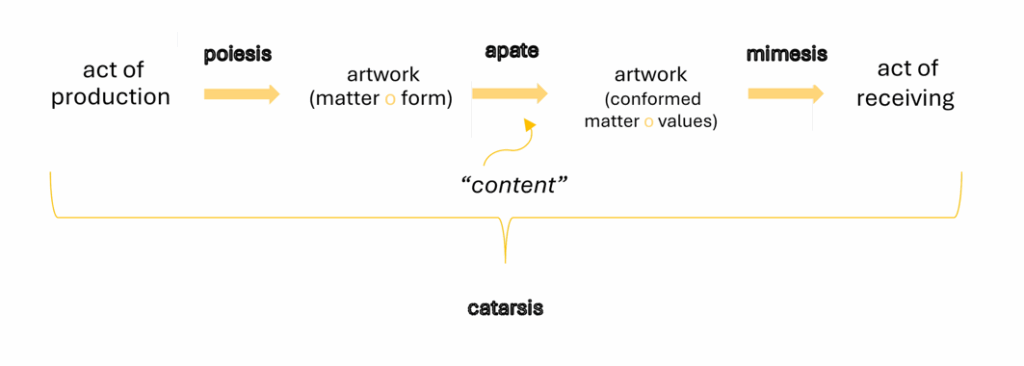
Similarly, the relationships between the parts of our aesthetic experience can be part of the central system. Consider again the expression we gave to a general aesthetic experience (Image 2):
Fractal logic is not a linear, causal logic; the diamond represents the areas of acceptance and rejection of the relations carried out in the central part. In other words, the successive compositions formed from the relationships of our aesthetic experience will indicate to me the effectiveness, or catharsis of it. The following image shows a diamond, specifically a type 4 diamond, because there are four entities that make up its central part. The categorical relations have been replaced by their initials (p, a, m, c):
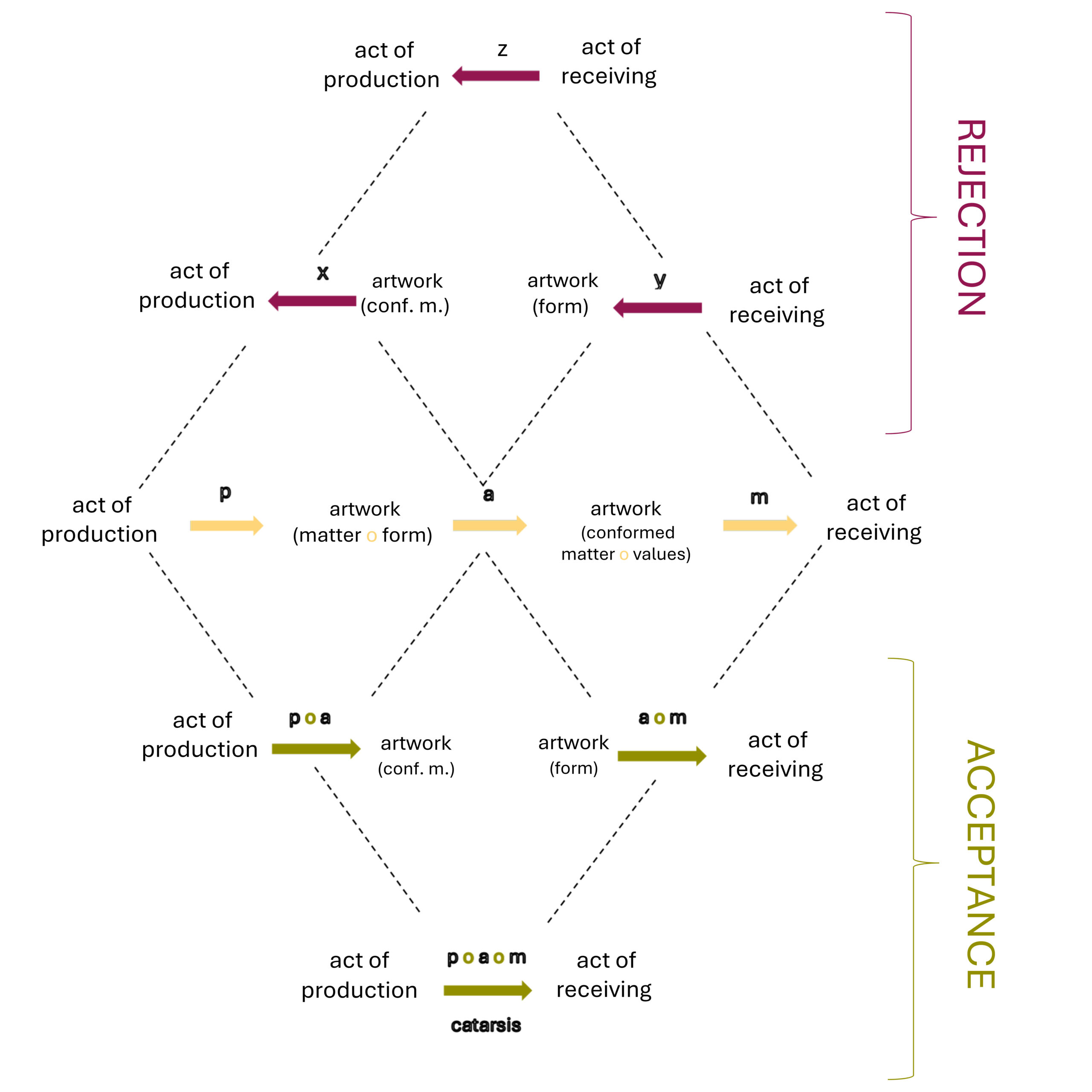
If we look at the part of the diamond that shows the green area of acceptance of an aesthetic experience, we see that for certain entities to be articulated, that is, for these relations to occur, a categorical composition must be carried out. The interesting thing about this is that it does not leave the weight of the effectiveness of an aesthetic experience in any of the relations but rather includes the articulation of all of them. For example, the act of reception of a work of art does not consist exclusively in perceiving the aesthetic object in its form, but this form must involve the composition of the apate and mimesis. In this way, in an aesthetic system, the entities ‘are not isolated but heterogeneous units, dynamic assemblages and networks that do not have a univocal meaning, are not completely determined’ (Najmanovich 2005, p.31), although, as a complex adaptive system, there are constraints that shape certain developments and prevent others.
If we apply this diamond to my experience of the Odyssey ––between Homer and Montse–– we would get something like this:
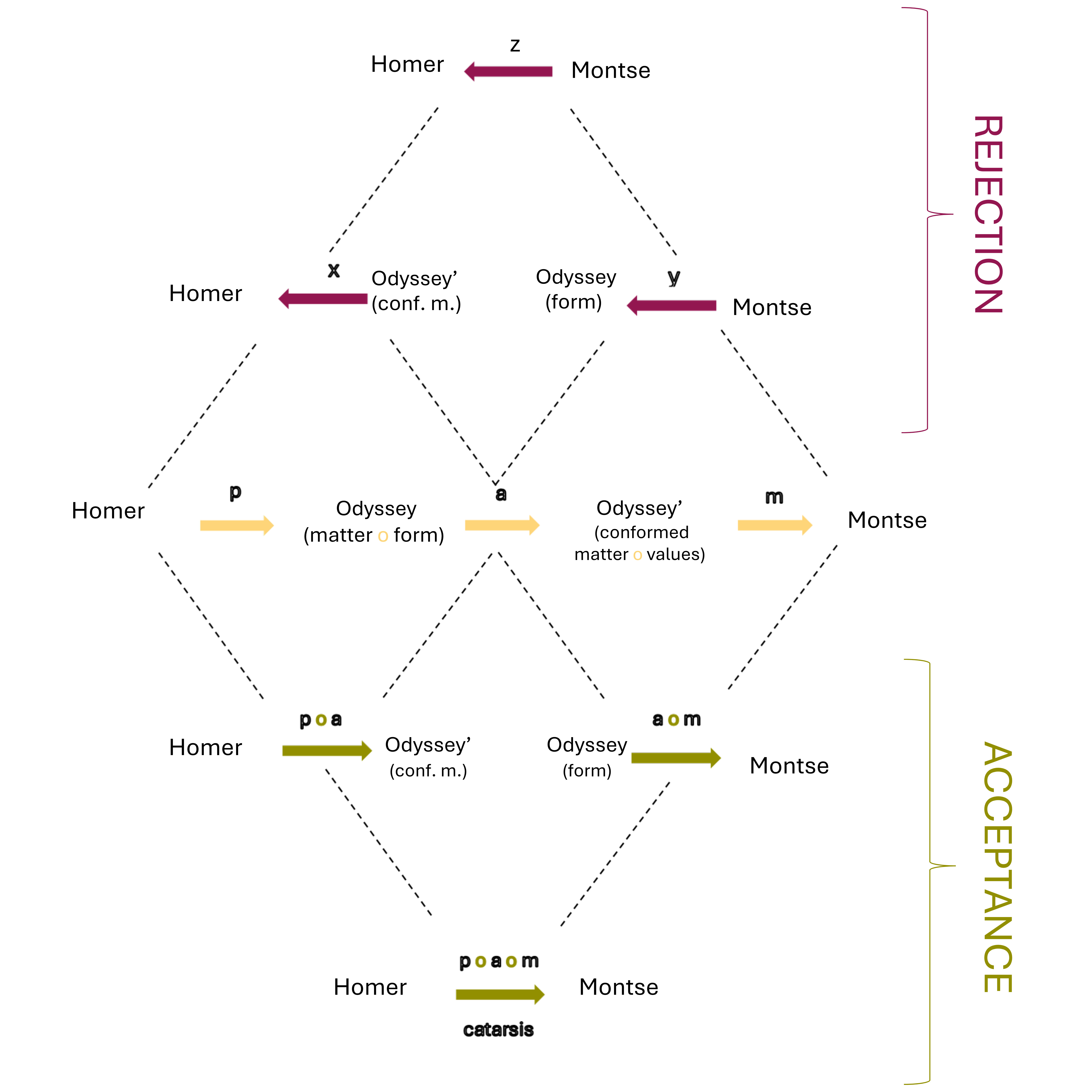
Reading the Homer-Montse diamond from the left, this aesthetic experience began a few centuries ago with the poiesis of Homer, who created a work of a matter and a form. The form of the work is composed of twenty-four songs that tell the story of the return of a hero of the Trojan War. It draws from a dark time, the era of heroes. However, rather than dwelling on a bygone era of political idealism, he emphasizes the return and the potential for a future in the home that existed prior to the war. Ulysses must apply all his ingenuity to overcome the obstacles life presents (Nicolson 2015, pp. 59-60).
In the pre-classical Greek world, Homeric works were recited orally. They were characterized by their sonorous, rhythmic, communicative nature, and structured in verses that were memorized and sung to an audience. For a considerable period, it was widely accepted that the matter of the Odyssey was a text, that it had been written in its original form. The eighteenth-century scholar Richard Bentley was among the first to consider the possibility that both the Iliad and the Odyssey were originally songs to be sung but not written. As a result of the twentieth-century research of Milman Parry, the poetic musicality of the Odyssey is now indisputable. The subject matter of the Odyssey was the sonority transmitted through oral tradition (Nicolson 2015, pp. 69–70, 77).
As outlined in the Homer-Montse diamond, in this century, I receive a work of conformed matter, with content, translated from the Greek and ready to be read. For my aesthetic connection with the Homeric work to be effective, I must be able to recognize its materiality in some way. I will only be able to connect with the story of Ulysses through a conformed matter that allows me to apprehend its aesthetic values, that behaves in a particular way according to its format. In this century, the Odyssey has been translated into numerous languages, adapted into film and anime, and performed in opera and comics, among many other adaptations. Additionally, the themes it presents are reflected in other works, although Homer is not explicitly cited. The conformed matter that I receive today is related to the composition elaborated by Homer almost thirty centuries ago. Certainly, my perception of the Odyssey could not have been foreseen by Homer.
Let us look at the relations of categorical composition that take place in the zone of acceptance, that is, those that indicate the steps that must be fulfilled according to Rudolf Kaehr’s diamond for this aesthetic experience to be effective. Starting from the left we see the first composition (p o a), which composes the poiesis with the apate. It is of great importance because it is linked to the content of the work: it articulates the structure of the object that has been made by the artist, and the structure taken by the receiver. It connects Homer ––as the productive act of the Odyssey–– with the work I receive in the XXI century––the aesthetic object as conformed matter. The effectiveness of the aesthetic experience of a work of the VIII century B.C.E. in the XXI century will be linked to the articulation between the capacity of its materiality to produce an apate considering its poetic elaboration. The artist cannot control the illusory effect (apate) of his work, i.e. how the structure he has formed out of matter will behave over time, how it will be received. For this experience to take place centuries later, the aesthetic object produced must be able to appeal to my imagination, it must be adequate to my contemporary reception.
Similarly, the subsequent composition (a o m) is constituted by apate and mimesis. It links the Odyssey in its formal aspect with me ––Montse––. Although the work is not exactly the same, it has formal aspects ––like the structure, the themes, and the characters–– that I can perceive, apprehend and recognize despite the temporal and cultural distance. In this aesthetic experience, the receiver, Montse, connects with Homer through the formal aspects of his poietic elaboration, not through the matter ––Greek orality.
Finally, catharsis will occur when the set of relationships that go from the author of the aesthetic object to the person who receives it, in this case myself, are intertwined with great effectiveness. The stronger the links between the two entities, the greater the capacity for catharsis the aesthetic experience will have.
Like an attractor, this diamond describes the behaviour of an aesthetic experience. We have seen that a fractal is an attractor whose structure repeats itself, and we have also said that the diamond behaves like a fractal. If we repeat the structure of the diamond in one of the relations that make it up if we diamond the relation in the diamond, we will have a fractal that will allow us to analyse, describe and understand the complexity of the aesthetic relation in question. Let’s approach the first relationship, poiesis, and make a diamond’ within a diamond, a fractal:
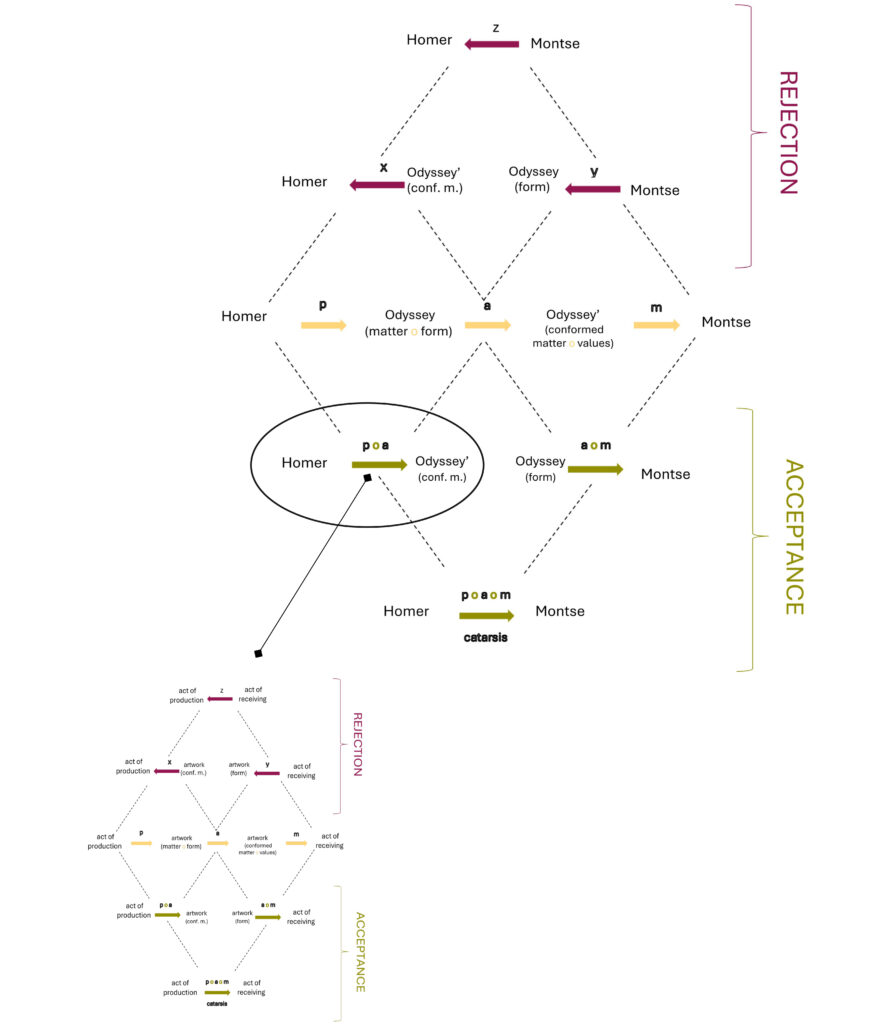
To diamantise poiesis is to ask ourselves: who created the Odyssey in the first place? Homer would be a simple answer. Although this can become a broader discussion, as there are many theories about it. Greek prose was not written in Homer’s time and there are no biographies of Homer or his contemporaries. There are, however, several poems or songs about the rage of Achilles and the adventures of Ulysses. However, given the compositional unity of the Iliad and its connection with the Odyssey, we will take the poetic act of these works in Homer (Lane Fox 2024, pp.21, 73, 75, 216).
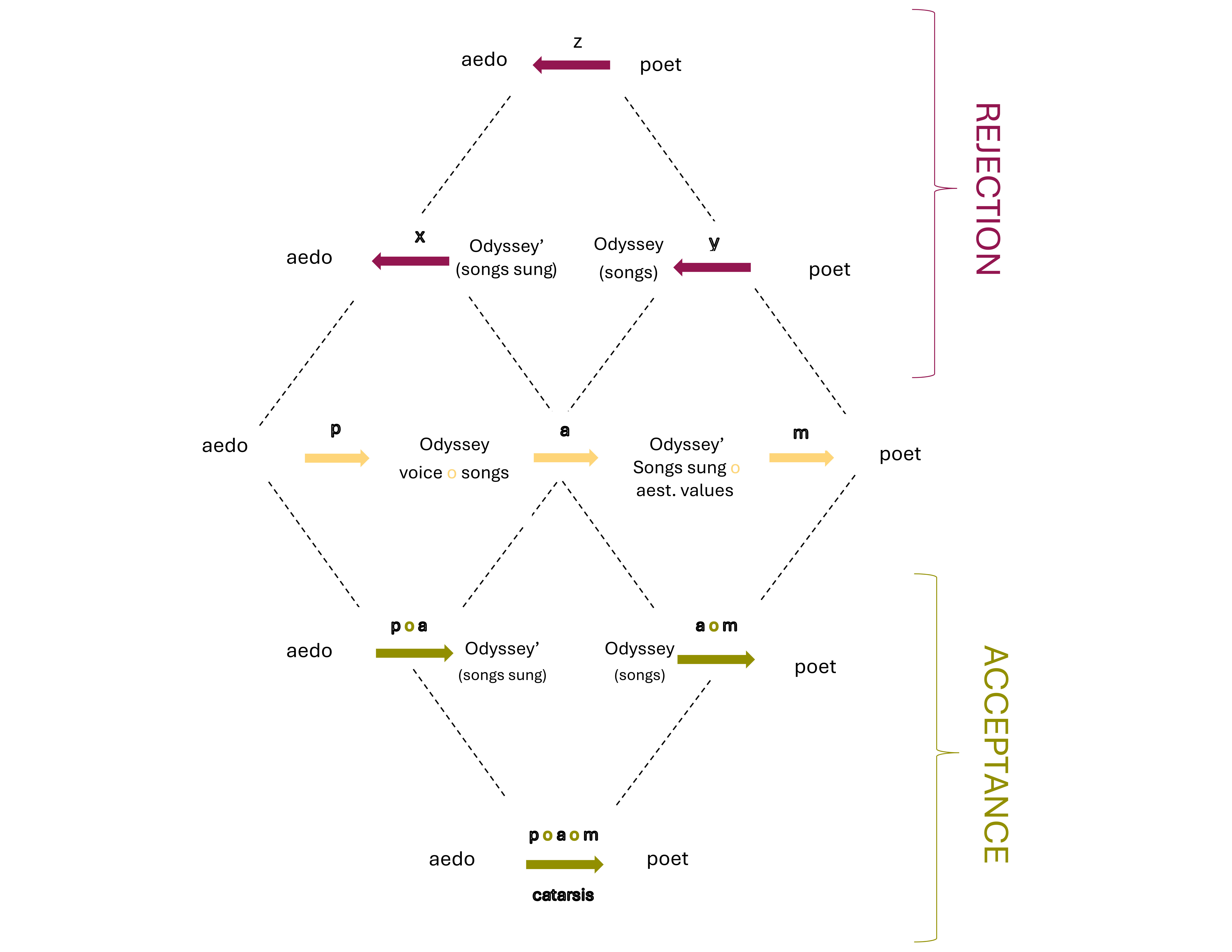
The Odyssey was written at a time when oral tradition was deeply rooted in society. The oral poets, the aedos, performed at the great festivals or banquets of the aristocracy. Because of the length of the whole story, they performed the songs in different sessions. Each time a poet sang a part of the whole story to the public, he published his poem. He put his own stamp on it: the tone of his voice; the details, related to the place where the event took place, to win the affection of the audience; the length of the episodes, according to the mood and atmosphere of the room… and so on.
Around the VIII century B.C.E., the alphabet revolution would begin to shape the tradition of memory, of language, even of the thought process itself and, of course, of authorship. It is quite possible that our Odyssey first took shape to be recited and then was written in 12,000 verses by a poet or alphabetical editor who added the final details (Lane Fox 2024, p.85). In this case, the diamond’ within the poiesis relation of my first diamond ––Homero-Montse–– would follow this logical structure:
Another possibility would be to consider the thesis of Samuel Butler, who argued that Homer was a woman, the daughter of the king of Sicily, hiding behind the character of Nausicaa, princess of Facia, daughter of Alcinous and Areté (2022, p. 101). Robert Graves took Butler’s thesis as a starting point for his novel Homer’s Daughter (2023). In this book he proposes that Nausicaa invented the Odyssey in the first place, drawing inspiration from her own life and other fables, and passed on the poems she wrote to an aedo who sang his Odyssey to anyone who would listen, often members of the aristocracy. In the narrative proposed by Graves, the diamond in the relation of poiesis of my first diamond ––Homer-Montse–– would follow this logical structure:
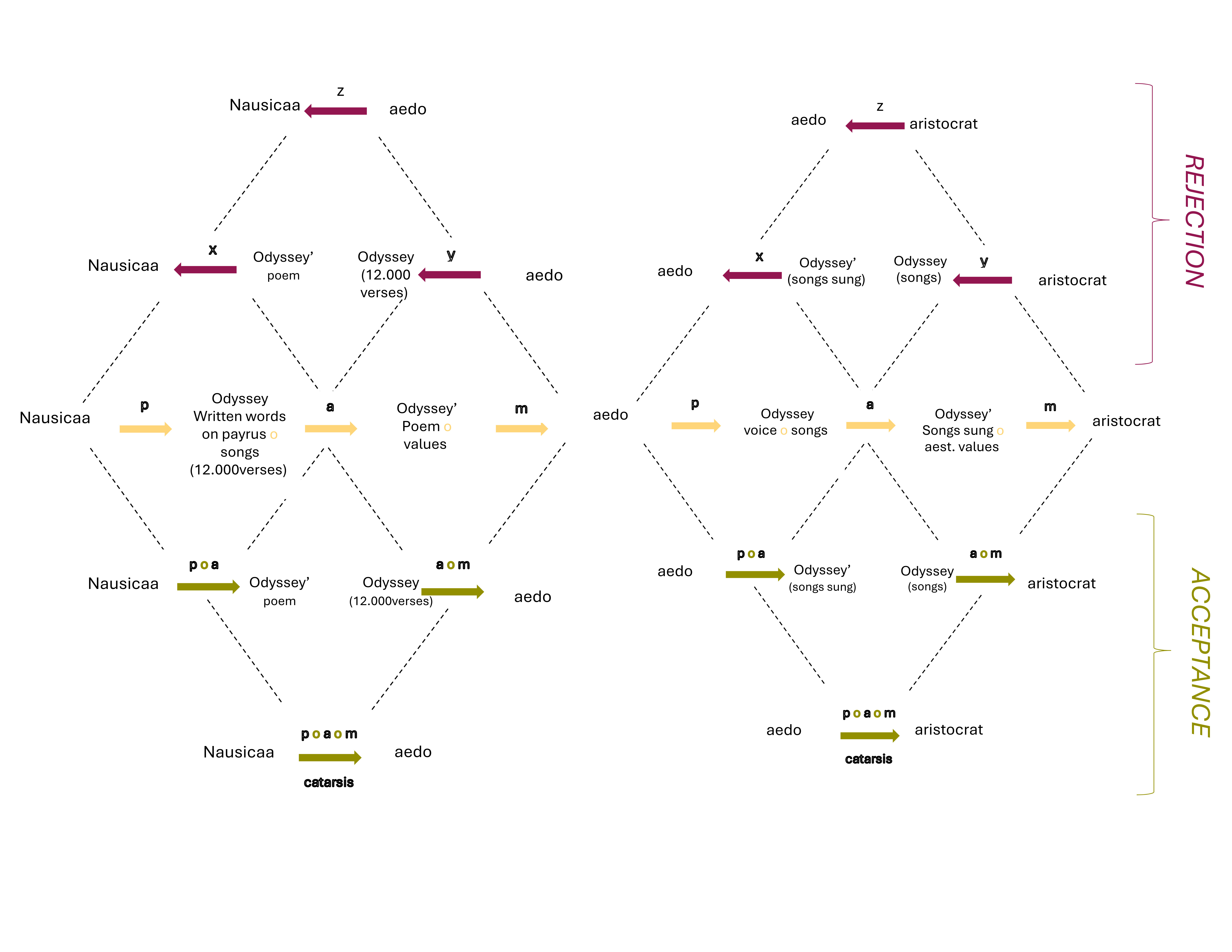
Aesthetic experience has a transforming and contagious power, capable of inspiring new behaviours and elaborations, whether artistic or not. Some aesthetic experiences lead to others that drink from previous sources. An example of this can be found in Aristotle himself and his perception of the Odyssey, which led to its inclusion as a model for a complex fable in his Poetics. We could describe the intertwining of these experiences in terms of diamonds:
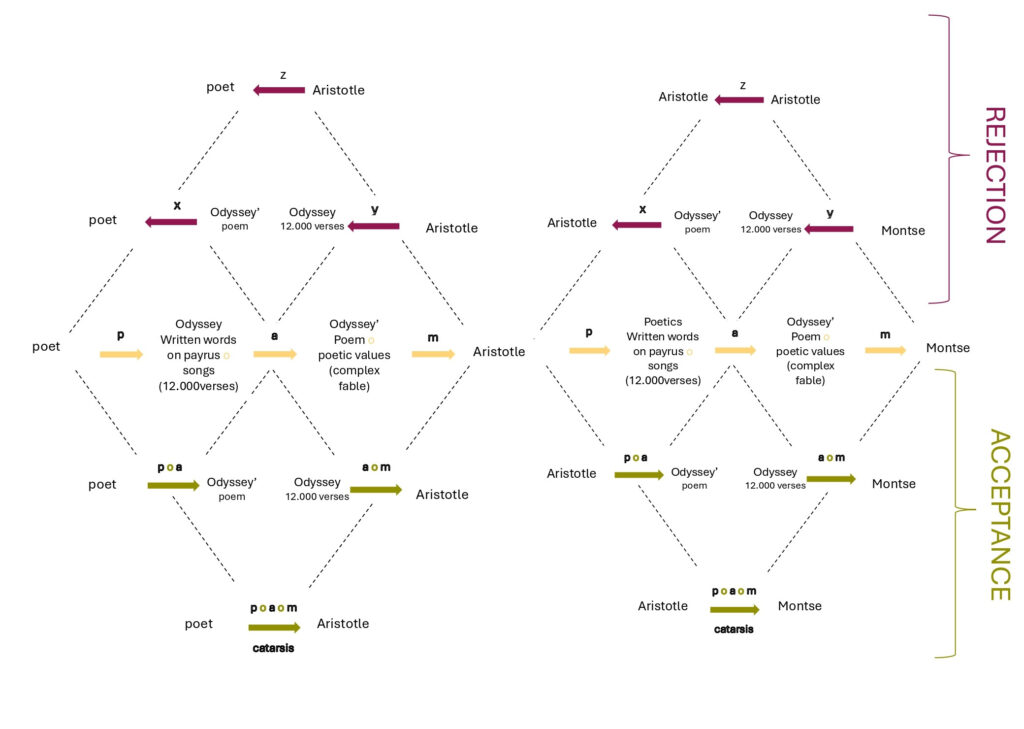
This diamondisation can be applied to each one of the relations of the initial aesthetic experience. In the relationship between the work conformed with values and my reception, that is, in mimesis, we will have to consider several factors. In my case, my experience of the work has been enriched by the many retellings of the classic that I have read since childhood. I consider the new readings that, from a feminist perspective, have given voice to many of the female characters in Homer’s work. Examples include Penelopiad, by Margaret Atwood; the trilogy on Ithaca, by Claire North; A Thousand Ships, by Natalie Heynes; Circe, by Madeleine Miller; Daughters of Sparta, by Claire Heywood, etc.
These examples from the Odyssey and the diamonds I can draw from my initial experience of the classic, demonstrate the complexity inherent in any aesthetic experience. Our sensibility, art and culture cannot be reduced to cause-and-effect relationships, but to have a greater understanding of the factors that connect us to art throughout history. ‘The bonding dynamic is the source from which both elements and relationships emanate; it is through it that complex systems emerge, which are always heterogeneous togetherness in permanent exchange with an active context’ (Najmanovich 2005, p.33).
Conclusion
In this article we have addressed aesthetic experiences as adaptive dynamic systems, whose intelligibility entails the overcoming of mechanistic and dualistic models. Aesthetics as the study of our sensibility, art and culture, shows that production, reception and processes linked together with historical contexts, form a self-organized relational framework. This perspective emphasises the processual and situated nature of experience, going beyond its reduction to the object-subject relationship.
The application of Rudolf Kaehr’s diamond logic has allowed us to map the complexity of our relationships with art. In their fractality, diamonds provide us with a conceptual tool from which to iterate the structure that is repeated in each of the relationships of our aesthetic experience ––poiesis, apate, mimesis and catharsis–– showing how each aesthetic node opens to new combinations. In this framework, the Odyssey has served as an example for us to move from oral tradition to contemporary reworkings, illustrating the plasticity of the classics. Their emergence in every aesthetic experience can be demonstrated in their ability to continue contributing values and reconfiguring the aesthetic system, adapting to the sensitivity, aesthetic objectuality and culture of each historical period.
Thus, the application of Kaehr’s diamond theory to artworks and artistic practices whose materiality is not textual, such as the visual arts or the living arts, would be the target of future research. On the other hand, this analysis has privileged the historical dimension of the work, to the detriment of contemporary reception. It would be interesting to take up this analysis of the feminist retellings of the Odyssey to understand how political and cultural factors influence the aesthetic system and cause emergences.
These limitations, far from weakening the proposal of this work, invite us to extend the study of this thought. Aesthetic complexity is proposed as the ideal terrain from which to integrate other disciplines and propose alliances between art and science. By means of this, we will gain understanding about the circulation, conservation and transformation inherent to aesthetic dynamics.
Works Cited
Aristóteles. (2010). In García Yebra V. (Ed.), Poética de Aristóteles (Ed. trilingüe. ed.). Madrid : Gredos.
Barnsley, M. F. (1993). Fractals Everywhere. San Francisco: Academic Press.
Bishop, R. C. (2022). Contextual Emergence: Constituents, Context and Meaning. In S. Wuppuluri, & I. Stewart (Eds.), From Electrons to Elephants and Elections: Exploring the Role of Content and Context (pp. 243–256). Springer International Publishing. 10.1007/978-3-030-92192-7_15
Butler, S. (2022). La autora de la Odisea (M. Cisneros Perales Trans.). Athenaica.
Claramonte, J. (2021). Estética modal : libro segundo. Madrid : Tecnos.
Claramonte, J. (2016). Estética modal. Madrid : Editorial Tecnos.
Gell-Mann, M. (1995). El quark y el jaguar: aventuras en lo simple y lo complejo (2ª ed.). Barcelona: Tusquets.
Graves, R. (2023). La hija de Homero (F. Mazía Trans.). Alianza.
Haraway, D. J. (2016). Staying with the Trouble. Making Kin in the Chthulucene. Durham and London: Duke University Press.
Hartmann, N. (1964). Ontología. Volumen V (1ª en español ed.). Fondo de Cultura Económica.
Hartmann, N. (1977). Estética (1ª ed. en español. ed.). México : Universidad Nacional Autónoma de México.
Juarrero, A. (2023). Context changes everything (1st ed.). Massachusets Institute of Technology. https://doi.org/10.7551/mitpress/14630.001.0001
Juarrero, A. (2010). Intentions as Complex Dynamical Attractors. In J. H. Aguilar, & A. A. Buckareff (Eds.), Causing Human Actions: New Perspectives on the Causal Theory of Action (pp. 253–275). The MIT Press. https://doi.org/10.7551/mitpress/9780262014564.001.0001
Kaehr, R. (2017). In Paul J. (Ed.), The Book of Diamonds/Diamond Theory: Colletions of Papers and Fragments (Sommer Edition ed.). Vodenker. https://www.vordenker.de/rk/rk_Diamond-Theory_collection-of-papers-and-fragments_2007.pdf
Kocić, &., Ljubiša M., Stefanovska, &., & Liljana. (2019). Complex Dynamic of Visual Arts. Chaos and Complexity Letters, 13(2-3)
Kocić, &., Ljubiša M. Art Elements in Fractal Constructions. Visual Mathematics 4.13 (2002): 0-0. <http://eudml.org/doc/256851>.
Lane Fox, R. (2024). Homero y su Ilíada. Editorial Crítica.
Maldonado, C., Torres, L., Yaver, C., Brill, D., Cendales, M., García, D., Rueda, C., Rivera, N., Rivera, J., & Martínez, S. (2021). Estética y Complejidad. Elementos para un estado crítico del arte. Corporación Creación – Arte & Ciencia.
Mitchell, M. (2009). Complexity: A Guided Tour. Oxford University Press, Inc.
Najmanovich, D. (2005). Estética del pensamiento complejo. Andamios, 1(2), 19–42. http://www.scielo.org.mx/scielo.php?script=sci_arttext&pid=S1870-00632005000300002&lng=es&tlng=es
Nicolson, A. (2015). The Mighty Dead. Why Homer Matters. William Collins Books.
Tatarkiewicz, W. (2016). In Jiménez J., Dziemidok B. (Eds.), Historia de seis ideas: arte, belleza, forma, creatividad, mímesis, experiencia estética ([8ª ed. en la col. Neometrópolis, reimp.]. ed.). Madrid: Tecnos.
Vallejo, I. (2019). El infinito en un junco. la invención de los libros en el mundo antiguo. Madrid: Siruela.
Vernant, J. P. (2002). The Universe, the Gods, and the Men: Ancient Greek Myths (L. Asher Trans.). (1ª ed.). HarperCollins Publishers.
Montserrat Sobral Dorado is a PhD candidate in Philosophy at UNED [Universidad Nacional de Educación a Distancia], where she holds a predoctoral fellowship (FPI). Her research explores the relationship between eroticism, aesthetics, and complexity, with publications in journals such as Athens Journal of Philosophy and Éndoxa, as well as contributions to edited volumes and translations, including co-translating Ellen Dissanayake’s Art & Intimacy. She collaborates in teaching aesthetics and art theory at UNED. Alongside her academic work, she has experience in curatorial projects, cultural mediation, and philosophy initiatives, such as the program El Nervio Estético.