Itsnatani Humaira Anaqami
Emergence refers to the process by which new forms, concepts, or behaviors arise from the interaction of simpler elements, often in ways not immediately apparent from those elements alone. This essay reflects on the dialogue exhibition Differences in Kind and Rhythm, featuring works by Italian painter Giorgio Griffa and New Zealand sculptor Peter Robinson, who approach the idea of emergence through distinct artistic practices.
Griffa, an influential abstract painter, works on unstretched canvases, layering repeated lines, symbols, and numbers to evoke incompleteness and open-endedness. His marks suggest processes that are ongoing rather than fixed, allowing patterns to unfold beyond the canvas itself. Robinson, drawing on Māori visual traditions and modular construction, creates sculptural installations composed of small repeated elements that coalesce into new, complex spatial forms.
Despite their differences in generation, medium, and cultural background, both artists share a focus on rhythm, repetition, and process. Spanning works from 1972 to 2025, the exhibition demonstrates how repetition functions not only as structure but also as transformation, producing unexpected connections between distinct artistic languages. Ultimately, it demonstrates how recurring forms, whether drawn, painted, or built, can foster new ways of seeing and becoming.
Repetition and rhythm have long been an essential part of art and remain relevant as both art and time evolve. Their use can be found in all types of art, from music and visual arts to literature.
In the dialogue exhibition series titled Differences in Kind and Rhythm, artists Giorgio Griffa and Peter Robinson demonstrate the use of rhythm through repeated forms in different types of art and across generations. Despite coming from different generations, backgrounds, and contexts, the conversation between the two artists, presented through this exhibition, reveals how they use repetition and process in their work to explore related concepts such as repetition and difference, emergence, and continuum.
This exhibition brings together the works of two artists from distinct disciplines: Giorgio Griffa, a painter, and Peter Robinson, a sculptor. Giorgio Griffa, born in Turin, Italy in 1936, is an influential abstract painter who began developing his unique visual language in the late 1960s. His works often feature lines, dots, curves, numbers, and letters applied to unprimed, unstretched canvases, emphasizing process, repetition, and incompleteness.
Peter Robinson, born in 1966 in Ashburton, New Zealand, is an artist of Māori (Kāi Tahu) descent known for his sculptural and modernist practice. A graduate of the Ilam School of Fine Arts at the University of Canterbury, Robinson rose to international prominence in the 1990s and participated in major events such as the 1998 Biennale of Sydney. In addition to his artistic practice, he is also active in academia and currently serves as an Associate Professor in the Faculty of Arts and Education (Fine Arts) at the University of Auckland.
While each artist employs a different medium, their practices are united by a shared emphasis on repetition. Spanning a period from 1972 to 2025, the exhibition not only highlights the parallels in their approaches but also creates a dialogue across different generations and artistic contexts.
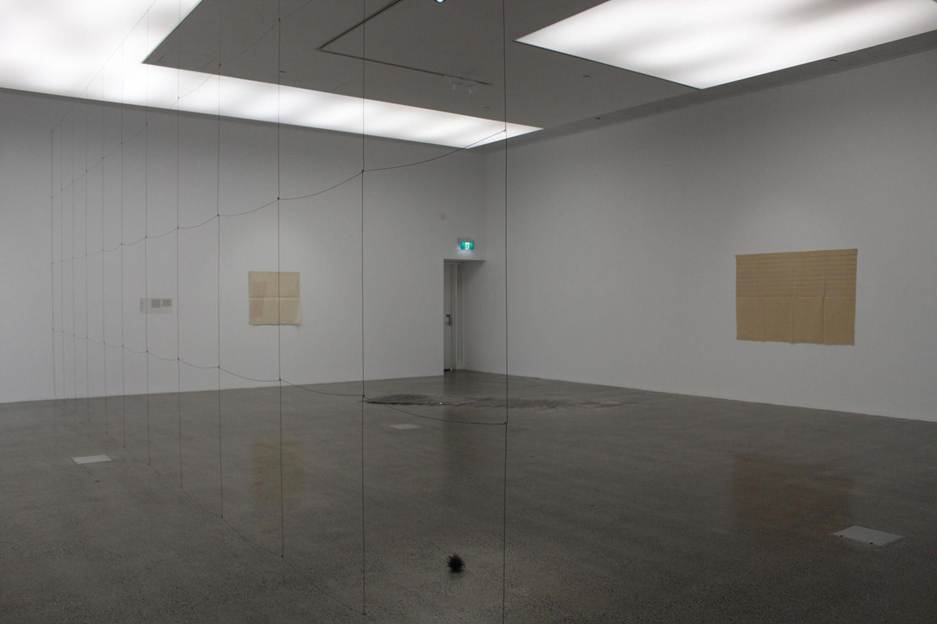
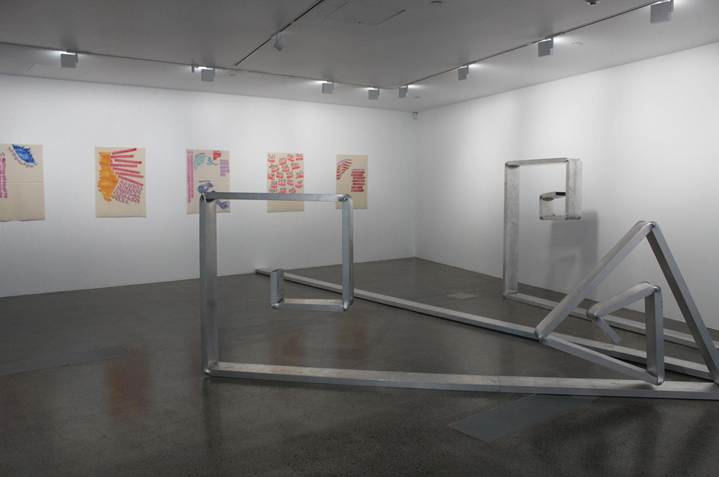
Giorgio Griffa and Peter Robinson: Differences in kind and rhythm, installation views, Te Uru, 2025. Courtesy the artists.
The exhibition begins in the first gallery, where the gallery shows artwork in ‘basic’ repetition and rhythm through a series of installations. Upon entering, visitors are greeted by a suspended structure made of interlocked aluminum pieces forming a loose square grid. This installation, called Tukutuku by Peter Robinson, draws inspiration from Māori art forms. The work creates open, airy patterns that occupy visual space more through absence than mass. Rather than asserting presence through weight or density, the work instead engages the eye through what is left out, that is from its gaps, voids, and absences; forming an equally powerful visual presence.
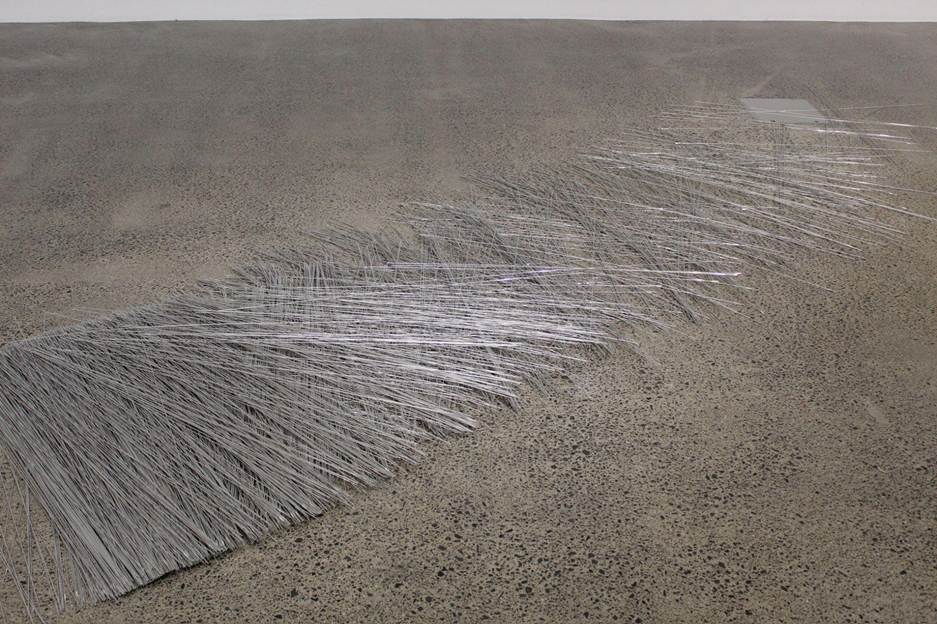
Peter Robinson, Piu 2, 2025, courtesy of the artist.
Another work, Piu, uses aluminum wires to form a tangled network of lines. These wires are dropped from a certain height, allowing gravity to determine their final shape. Each fall results in a unique configuration, introducing an element of randomness. The way the wires land looped, stretched, and intertwined creates new spatial forms.
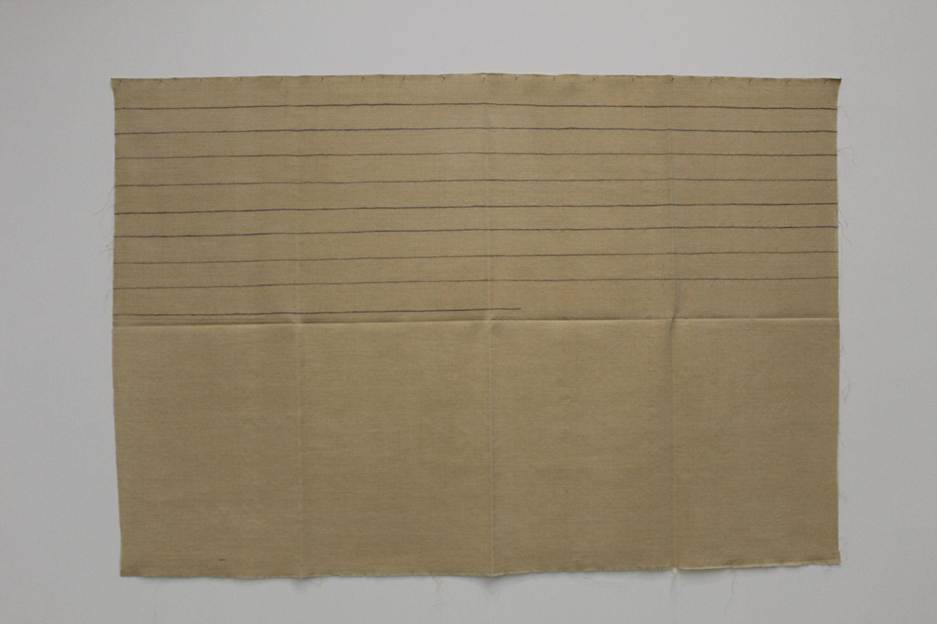
Giorgio Griffa, Linee orizzontali, 1974, courtesy of the artist.
In the same gallery, several paintings by Giorgio Griffa from the 1970s are also on display. These works are part of his first painting cycle, Segni Primari (Primary Sign). One of them, Linee Orizzontali (1974), presents nine horizontal lines, with the final line noticeably shorter than the rest. An intentional gesture suggesting incompleteness and the open-ended nature of the artistic process.
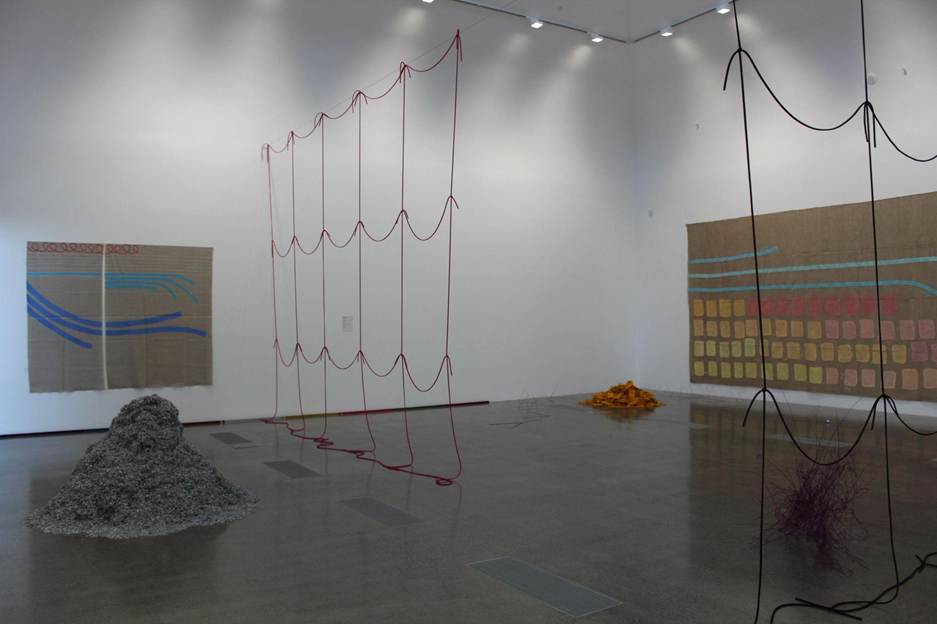
Giorgio Griffa and Peter Robinson: Differences in kind and rhythm, installation views, Te Uru, 2025. Courtesy the artists.
Moving into the second gallery, visitors encounter a selection of sculptures that are relatively larger in scale compared to those in the previous room. A square net structure stretches across the space like a partition, subtly shaping movement and visual flow. Alongside these sculptural works are several paintings, creating a dynamic interplay between two-dimensional and three-dimensional forms.
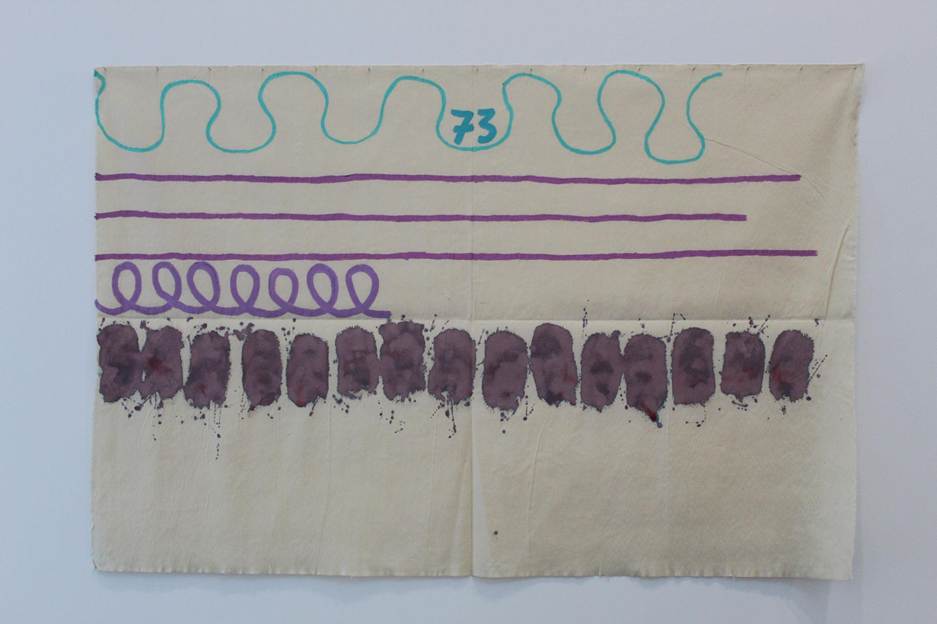
Giorgia Griffa, Tre linee con arabesco n.73, 1991, courtesy of the artist.
One of Griffa’s paintings in this room, Tre Linee Con Arabesco n.73, showcases a variety of line-based marks that come together in a single, cohesive composition. The work features different types of lines: straight, flowing, thick, and thin. Repeated across the canvas to create rhythmic variation. Griffa describes his use of these varied signs as akin to a community: each mark is distinct, yet they coexist as part of the same group. Much like in nature, individuality and unity are held in balance, allowing difference to contribute to harmony.
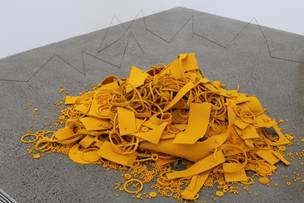
Peter Robinson,Yellow Slump, 2016, courtesy of the artist.
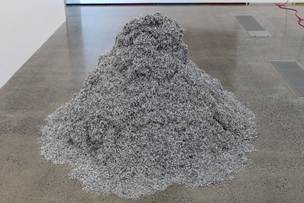
Peter Robinson, Swarf, 2025, courtesy of the artist.
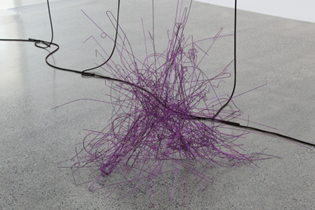
Peter Robinson, Purple Haze, 2018, courtesy of the artist.
On the other side, Robinson presents an installation composed of small modular elements arranged in repeated or sequenced patterns. These modest units, when viewed collectively, evolve into something entirely new: An emergent form that transcends its individual parts. As visitors follow these visual sequences, they are drawn into a process of transformation and becoming, where new ‘beings’ continually surface.
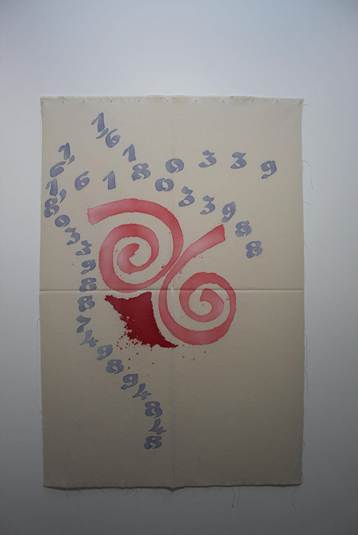
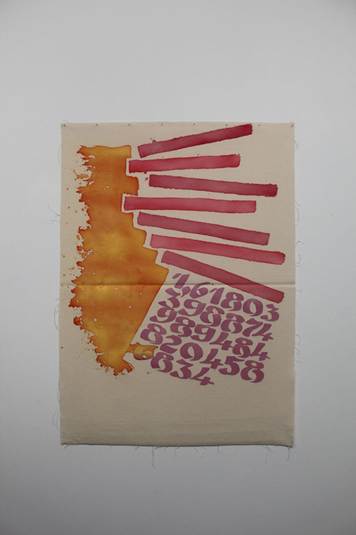
Giorgio Griffa and Peter Robinson: Differences in kind and rhythm, Te Uru, 2025. Courtesy the artists.
Giorgia Griffa,Canone aureo 848, 2017, courtesy of the artist.
Giorgia Griffa, Canone aureo 834, 2017, courtesy of the artist.
Moving into the last gallery, both artists present works based on a shared theme: the golden ratio. Despite approaching it through entirely different mediums, they each interpret the concept with remarkable clarity and individuality.
Griffa, who often incorporates numbers in his paintings to indicate their position within a series, takes this further by integrating the golden ratio itself as a subject. Expressed as the irrational number 1.6180339…, the golden ratio is known for never quite reaching 1.7, and is often visually represented as a spiral. In his paintings, Griffa explores this form through a combination of spiraling shapes and numerical sequences.
On the other hand, Robinson draws on the presence of the golden ratio in nature such as in the spiral of a snail shell and relates it to koru, a symbol in te ao Māori that represents new beginnings and the continuous cycle of life. His sculptures echo this idea through repeated spiral forms, capturing the sense of motion and eternal return that the koru embodies.
Overall, The exhibition is exceptionally well-curated, with artworks thoughtfully divided and categorized. The sequence flows seamlessly, beginning in the first gallery, which introduces the overarching theme through simple and basic forms of repetition, primarily featuring two-dimensional installations. The second gallery builds upon this foundation by presenting more complex expressions of rhythm and repetition, expanding to include both two-dimensional and three-dimensional works.
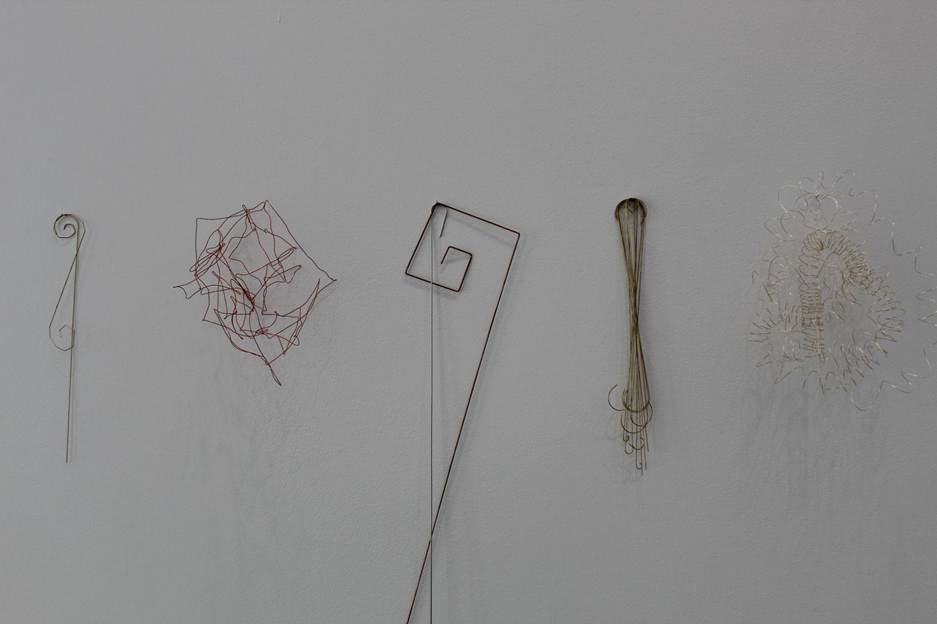
Giorgio Griffa and Peter Robinson: Differences in kind and rhythm, installation views, Te Uru, 2025. Courtesy the artists.
The transition between the second and third galleries is particularly effective, featuring a series of smaller-scale wall-mounted sculptures along the connecting aisle, serving as a preview of what is to come. This leads visitors to the third gallery, which serves as a fitting finale, showcasing the largest sculpture in the exhibition alongside an engaging collection of paintings that explore diverse approaches to using lines and numbers in art.
The exhibition successfully fosters a compelling dialogue between the two artists, with each artwork echoing the shared themes of repetition and rhythm. It serves as a powerful reminder of the transformative potential of small repeated elements. In art, a single line drawn multiple times can evolve into a captivating composition, just as modular forms arranged in sequence can give rise to entirely new structures. Beyond the gallery, this idea resonates on a more personal level. It reminds us that even the smallest thing in life, like habits, whether good or bad, when repeated consistently, have the power to shape and transform us, perhaps into an entirely new version of ourselves.
Itsnatani Humaira Anaqami is an architect based in Indonesia with a strong interest in the arts. She is currently pursuing a Master of City Planning at the Weitzman School of Design, University of Pennsylvania, USA. Her academic focus is on urban design, driven by a commitment to fostering healthy and inclusive cities through design-based interventions. Alongside her professional and academic pursuits, she continues to engage with the arts through writing and exploring exhibitions.