Lena Pozdnyakova
Aristotle suggests that the object is indispensable to human perception, or if you will, it gives itself to be perceived. It follows then that the process of perception or reading of the object is central in the discourse on the emergence of the objects as they appear in our cognition. Aristotle uses the analogy of an imprint, where he compares the sensation to the ring’s signature, imprinted onto the wax. In this sense, the imprint of the material happens without any matter being transmitted, In this sense, the imprint of the material happens without any matter being transmitted; however, the object’s presence is depicted.
In “The Order of Sounds: A Sonorous Archipelago,” François J. Bonnet depicts the sense of vision as the one that posits distances, assumes obstacles, and stakes out space. He brings it up in juxtaposition to sound, which has a non-tangible nature – it instead moves through the obstacles and transcends space. Despite the realm of operating through different instruments of perception and existing in different domains, we will see that sound object shares a common ground with an object of architecture and that the significant role in identifying any of the given objects is given to the auditor or the reader.


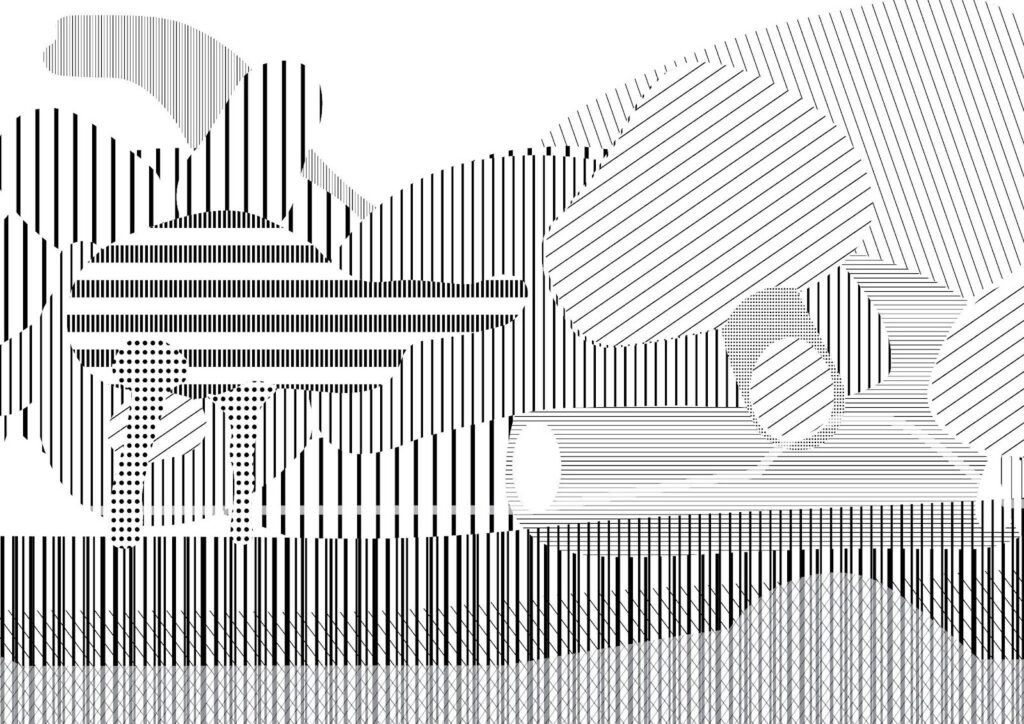
Fig.1, Fig. 2. Details of Architectural Objects. Physical models for the speculative design proposal to create a Museum of Sound Objects.
(Los Angeles, 2019)
Difficulty
Vitruvius famously outlined three key components as prerequisites for an Architecture: function, economy, and beauty. For the first two qualities in the list, we encounter the possibility for calculable analysis. However, with the latter, we seem to enter the domain of transcendental. Emmanuel Kant was among the ones who brought to the foreground the point of a shared experience as an a priori for judgment on what is it that we call “beautiful.” He suggested that for the share experiences, the aesthetics stands above all and that it unites minds. In other words, when we encounter something beautiful – it is expected that we will inevitably agree on this as a society. However, Kant hasn’t assigned any specific features or methods to the process of deciphering the beautiful. The notion of what is aesthetically beautiful simply had to be felt and shared. For Kant, the universality and necessity of beauty are products of the human mind, which philosopher refers to as ‘common sense’. It follows then that aesthetics becomes the premise for the dialogue, or so to say, a literary enactment of thought shared and practiced among the people. However, as there is no objective property of a thing that makes it beautiful, it is simply read and agreed to be such by the audience. Therefore the process of deciphering the form that catches and fascinates the eye and the mind, as well as the operation on discoursing about it comes to the foreground. Consequently, the reading process becomes central for such discursive practice. And precisely through the techniques of work with form, context, attention, and imagination, one can expect the sound object to relate to an architectural one. And while the Kantian notion of the beautiful romanticizes the collective agreement as a protocol for the encounter of the beautiful, it would be more useful to decipher the methodology from the position of the reader(s), as proposed in Roland Barthes’ “Death of the Author.” This perspective dissolves the singularity of agreement, displaces author’s intention and reveals the landscape of possibilities for reviewing the formal language as a discursive material by the audience.
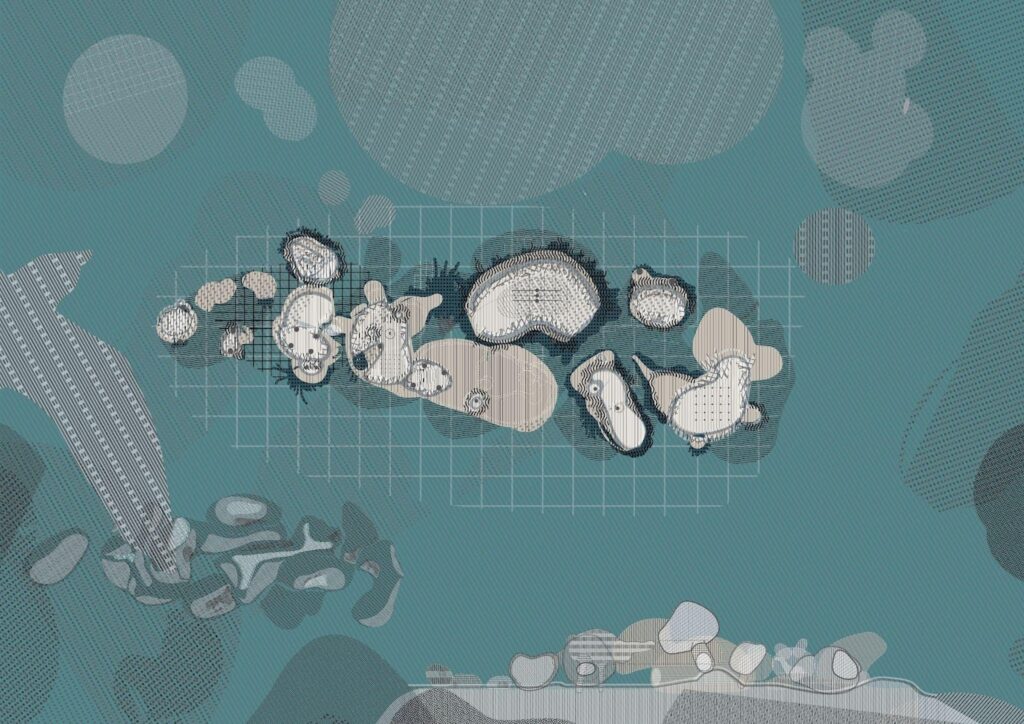
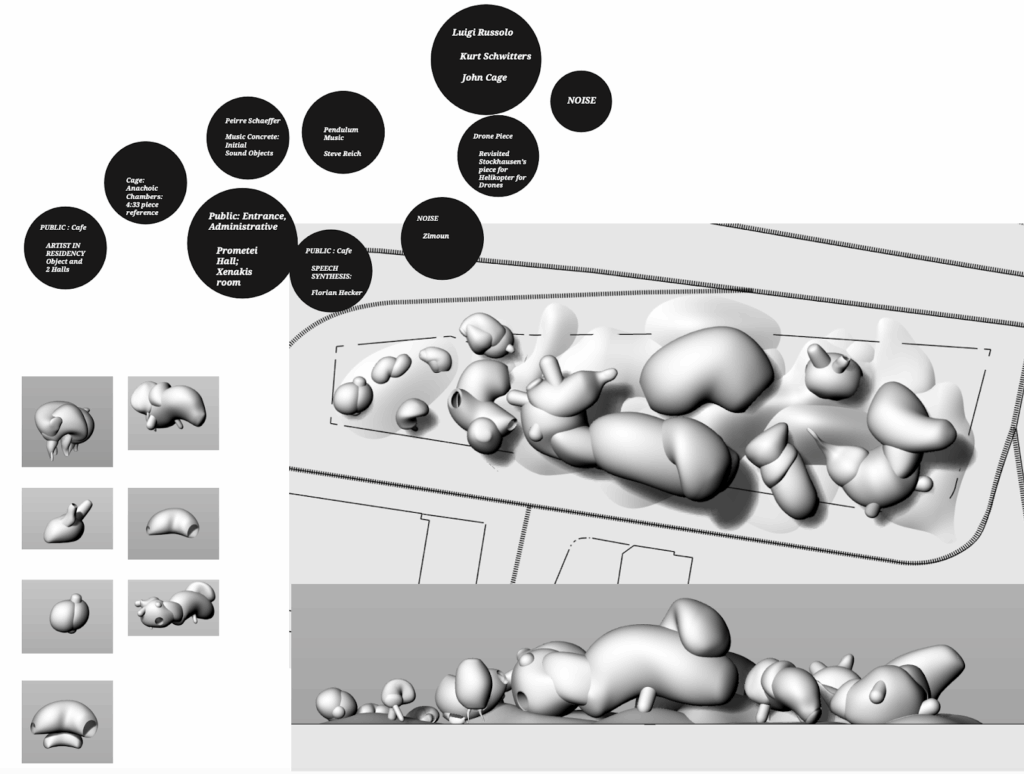
Fig.3, Fig. 4. Architectural drawings and schematic plans for the speculative design proposal to create a Museum of Sound Objects. (Los Angeles, 2019)
On Practical and Poetic
To overcome the difficulty of sound and architectural objects’ disciplinary boundaries, we might suggest the common ground that underlines the discursive and communicative premise for both objects – its form. We will do this by addressing the analogy in the field of literature.
Based on the Formal method of reading the units in literature, which introduced sound form in language as an abstract object, we can encounter an exciting shift from practical to abstract forms as material. As a method, the Formal approach suggests that this deviation in function puts “poetic” language in juxtaposition to “practical” language and allows for the investigation of literary material as an object.
In “The Sound in Verse Language,” Lev Jakubinskij brings up the possibility of language systems, where the practical aim retreats to the background without necessarily disappearing altogether. This position, according to Jakubinskij, allows the language resources to acquire autonomous value. Therefore, it follows that the object of attention, autonomous and discursive, possibly has the potential to remain in the realm where both practical and abstract forms are present. Notably, he points out that the autonomous value is an acquirable one. It was a radically new idea to bring the autonomy of form in the literature to the foreground, which drastically contradicted the Symbolist’s concept of reading the literary form through the language of “images.” Skolvsky saw “images” as borrowed from the other authors’ material, recognizable and static.


Fig.5, Fig. 6. Surface treatment of vessels for the Sound Objects as part of the speculative design proposal to create a Museum of Sound Objects.
(Los Angeles, 2019)
Pierre Schaeffer depicts the analogous thinking in his book “In Search of Concrete Musique” (1952). In the chapter “From the Object to Language,” he suggested the distinction between poetry and prose – it is regarded as an opposition between the figurative and the abstract. The latter eliminates the references and opens itself for the potential to express anything contained in it.
Jean Baudrillard, in “The First Interview”(2002) with Jean Nouvel, brings up the term “singular object” in architecture. He expresses interest “in anything in so-called “constructed” objects that enables me to experience the instability of space,” rather than in architecture. Jean Nouvel responds to Baudrillard, calling this phenomenon the “architecture as a limit,” or a “peculiar position on the fringe between the knowledge and ignorance.”
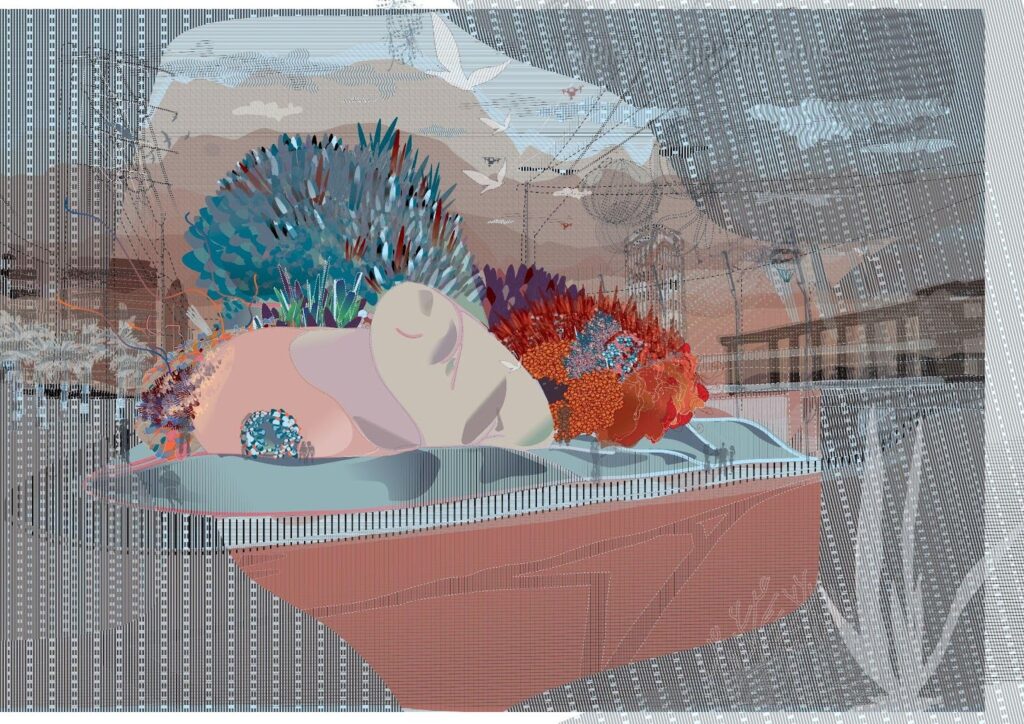
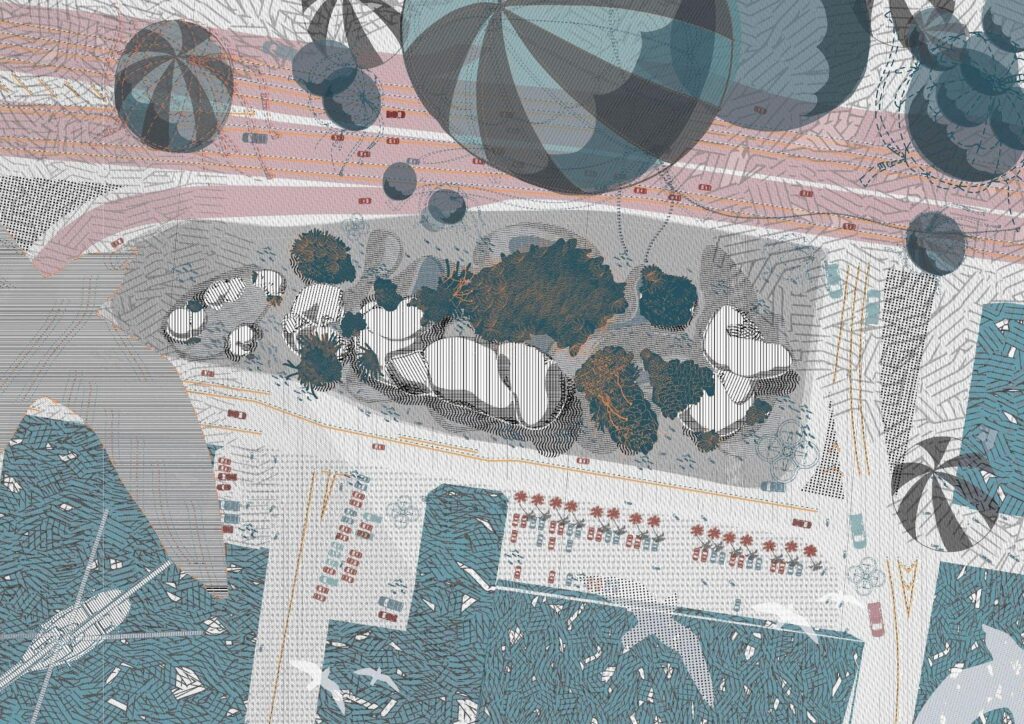
Fig.7, Fig. 8. Architectural drawings for the speculative design proposal to create a Museum of Sound Objects. (Los Angeles, 2019)
This reminds us of the phenomena applied in the theory of art and literature, described by the Russian Formalists in the early 20th century as augmented perception as a way to encounter art as an end in itself. According to Sklovksy, this point of special attention was occurring through the detachment of meaning that makes “recognizable” things accessible for comprehension. Sklovsky described this encounter as an encounter of “ostranenie,” which literally means finding it “strange.”
Similarly, in the interview with Jean Baudrillard, Nouvel calls the point where architecture positions itself – the place where the perceptions interact with one another and define the place we are “unfamiliar with.” “And whether this [meaning] resides in the work of art or something else, at any given moment the singular object is rendered enigmatic, unintelligible even to the one who created it…”, he points out. This objectivation of architecture brings it closer to the notion of that described by Sklovsky as “made strange” and unfamiliar. It then follows that architectural object reveals itself anew and differently to different readers, and this posits the question of the reader as an active participant at the moment of this encounter of the strange object.
Following the conversation between the architect and philosopher in “The First Interview”, it becomes clear that not every object built or designed desi is an architectural object. This suggests that an architectural object is not a given object but an object encountered with a particular state of attention. Architecture is also a “place as an extension of sight,” Nouvel suggests and brings up the senses’ role. While the viewer’s sight instrumentalizes the visual field, Barthes qualifies the targeting of sound – listening as the key deciphering process.
In the chapter Desiring-Listening, Bonnet specifies that the object that listening depicts presupposed a cut, and hence the sieving that defines it. This is analogous to the initial concept of the “sound object” introduced in the 1960s by Pierre Schaffer. A sound object can be distinguished as an intentional object and is opposed to the emitter-object. It is decontextualized and has an autonomous nature. Michael Choin describes Shaffaerian sound object as any sound phenomenon perceived as a whole and by means of reduced listening, which targets sound for itself, independently of its origin or meaning.

Fig.9. Model of an architectural vessel for one of the Sound Objects or the speculative design proposal to create a Museum of Sound Objects.
(Los Angeles, 2019).
Receiving – Reading – Deciphering
When the sonorous flux reaches the auditor, it does not penetrate the ear. It stays unheard and undetected. However, the mode of special attention, speaking with the Aristotelean metaphor, imprints the targeted object upon the sense. While the sound continuously flows and floods into the ear, the exercise of listening presupposes the method of selection and identification. Once again, we can refer to Bonnet, who underlines that listening is always driven by the will to listen. It is at once the embodiment of the two – listening and the intention to listen.
Similarly, the encounter of an architectural object is not a given fact. It is indeed a process of transformation of an object in the reader’s eye, which employs a particular reading technique as part of such encounter. The transformation of the visible into the readable activates the discourse’s regime and takes the visible as a singular object. Architecture, akin to literature and sound, employs a formal language to accommodate such encounters, and hence the process of “becoming an object” is of our particular interest.
The process of “becoming an object” of attention is analogous to “becoming-object of sound” by the use of Schaefferian reduced listening as to enter “harbor a mystery of transmutation.” The “mysterious harbor of transmutation” is often evoked by the “estrangement” device that Opoyaz members (an acronym for the Society for the Study of Poetic Language) referred to in the early 20th century in Russia.
The process of targeted reading, according to François J. Bonnet in “The Order of Sounds: A Sonorous Archipelago,” always embeds “desiring-listening,” which operates on the premise of fantasy. Similar to the proposition of shifting roles between the author and the reader proposed by Roland Barthes in “Death of the Author,” the roles between the reader of an architectural object and the author of architecture are swapped.
In the chapter called “Listening,” Barthes suggests that desiring-listening too underlines shifting roles. According to Barthes, listening speaks for both the sound and the author when the narration is developed within the reader’s fictional register. Such fiction opens up a new scenario, where the phantasmatic aspect’s importance takes over the Shaefferian sound object’s purism.
According to Bonnet, Shaeffer’s error was to believe that we find only the reason behind the abstraction. However, we also find desire and fantasy. Reduced listening does not lead us to rational or realistic space; it opens onto an abstract space – that is to say, potentially heterogeneous, but still a desiring-space.

Fig.10. Model of an architectural vessel for one of the Sound Objects or the speculative design proposal to create a Museum of Sound Objects.
(Los Angeles, 2019).
In “Desiring-Listening,” Bonnet brings up the concept of the “promise” as an instrument of seduction. The object becomes targeted and operates on the premise of anticipation. Therefore the object of desire, be it architectural or sound, that appears on the premise of the promise, is encountered on the entanglement of both fiction and sensorial perception.
Jean Nouvel speaks of the related concept in architecture, where he puts the architectural object as a space of seduction. He argues that architecture seduces and provokes through the strategies that employ play with form, illusion, and fiction. In the same manner, as with the sonorous input, the influx of signs with an architectural realm presupposes a similar cut in attention, activated by the defamiliarized encounter. And by virtue of this, an architectural object becomes a projection of the reader’s desire for fiction, combined with what has been detected by the senses. The attention to enter the phantasmatic realm seduces the viewer and reveals the space for imagination. “..if architecture wants what it wants and tries to signify what it wants to express, it will be deflected. […] something is present, but that something is nothing; there is nothing on the other side. Because where we see plenitude, masses, populations, statistics, and so on, there is always deflection. It’s this deflection of the operator,[…], that in a work of architecture or art transforms the way we use it, but also ultimately transforms the meaning that was originally given to the work,” suggests Nouvel in his interview with Baudrillard and gives the phantasmatic entrance into the architectural object.

Fig.11. Model of an architectural vessel for one of the Sound Objects or the speculative design proposal to create a Museum of Sound Objects.
(Los Angeles, 2019)
The lack
Following the analogy with the Aristotelian object, if the imprint of the sound or architectural object onto senses is similar to the imprint of the ring onto the wax, this scenario leaves us with the gap – the void that is left once the ring is removed. While this very loss allows for the abstraction, it also expresses the constant urge to fill the lack. Bonnet brings to attention the concept of the “lack” in “desiring-listening” process. The objectivation of sound material (or visual cut) is an expression of a desire to fulfill the lack, as Bonnet posits it. The selective nature underlines the reader’s or listener’s active participation and signifies the importance of the newly attained or yet appear objects of attention. The urge to fill the gap allows for the object to “speak.” This brings unique relational terms, where the listener indeed makes the sound object speak by activating it. The same happens once the reader is encountered with an architectural context, where the proposed object, obtained by the reader’s targeted attention, delivers information through the potential of its formal qualities, provided that the reader can decipher the information. In both cases, the reader and the listener grant the object with a discursive power and, in a Kantian sense, brings up the judgment of the form to the foreground, temporarily filling the gap by providing the newly attained reading and judgment to the public. It then follows that the reader of an architectural or sound object becomes the author of the fantasy that the object evokes. The object then gains the relational nature and provokes the discursive operation essential in the disciplinary terms, which frame the emergence of the object. Therefore we perhaps can refer to the attractor object as to the object of knowledge.
Baudrillard calls architecture ‘a mixture of nostalgia and extreme anticipation”, bringing up the literary reference of “lost object” as a language that operates in the temporal state of transition, signifying that something has been lost and something that is anticipated. “Form is always already lost, then always already seen as something beyond itself,” Baudrillard outlines.
This condition is especially interesting concerning architecture, as the duration of its utilization often stretches beyond one span of one lifetime, and hence for each new generation of encounters, it is about to bring a new revelation. Architectural objects exist in a continuous transitional dimension and reside in the tangible realm instead of the non-tangible media of sound.
Theodor Adorno suggested another interesting shift in the view towards the objects of attention. He called the objects of culture – commodified fetish objects. Both – sound and architectural objects, according to Adorno, are commodified cultural objects, as for the Adornian fetish-character is accountable to both socioeconomic as a pure product of commodity capitalism as well as the processes of consumption it produces, including the sensible implications. Adorno also speaks on fetishizing the listening process and hence brings up the immaterial objects into play, affiliating those with the commodification of the cultural domain.
This way, both sound object and architectural object, additionally to the abstract and formal qualities, represent another cut, a historical and socioeconomic chunk of information that predisposes its production as a matter of commodification. This information explicitly illustrates a very practical dimension, where objects that we are detecting become highly contextualized and serve other disciplines, functions, and purposes. This situation is another fascinating dimensionality extracted from the exercise of objectivation of architecture and sound.
The lack that we have started this chapter, perhaps could be seen as to signify particular voids in the histories around these objects and their time. This then requires us to aim attention at the objects in order to reveal the “unknown” to fill those gaps in history with newly revealed and imagined stories, depicted in architectural and sound objects that were once forgotten, neglected, or misused.
The importance of approaching the architectural object and sound object from the perspective of a lack lays in the frames mentioned above: its socioeconomic context as representative of a lack, its formal qualities as a premise for abstract reading and phantasmic reading, and relational operation as a discourse-generating practice within the disciplinary boundaries and outside of those.
Bonnet suggests that the process of listening always presupposes the listening to something and hence depends on the relation. He puts it as follows: “the joy of hearing is the joy of being in-relation.” This underpins the urge to find parallels between the architectural object and sound object in the first place and provides a promise of the common ground, regardless of the disciplinary boundaries, operating in relational terms with the culture at large through the “joy of being-in-relation.”
Bibliography:
Barthes, Roland. Image, Music, Text. Translated by Stephen Heath, Hill and Wang, 1977.
Barthes, Roland. “The Death of the Author.” Image, Music, Text, translated by Stephen Heath, Hill and Wang, 1977, pp. 142–148
Baudrillard, Jean, and Jean Nouvel. The Singular Objects of Architecture: A Conversation between Jean Nouvel and Jean Baudrillard. Edited by Jean-Loup Thébaud, translated by Robert Bononno, University of Minnesota Press, 2002.
Bonnet, François J. The Order of Sounds: A Sonorous Archipelago. Translated by Robin Mackay, Urbanomic/Sequence Press, 2016.
Chion, Michel. Audio-Vision: Sound on Screen. Translated by Claudia Gorbman, Columbia University Press, 1994.
Jakubinskij, Lev. “On the Sound in Verse Language.” Readings in Russian Poetics: Formalist and Structuralist Views, edited by Ladislav Matejka and Krystyna Pomorska, MIT Press, 1978, pp. 103–115.
Kant, Immanuel. Critique of Judgment. Translated by Werner S. Pluhar, Hackett Publishing Company, 1987.
Schaeffer, Pierre. In Search of a Concrete Music. Translated by Christine North and John Dack, University of California Press, 2012.
Shklovsky, Viktor. “Art as Technique.” Russian Formalist Criticism: Four Essays, translated by Lee T. Lemon and Marion J. Reis, University of Nebraska Press, 1965, pp. 3–24.
Vitruvius. Ten Books on Architecture. Translated by Ingrid D. Rowland, edited by Thomas Noble Howe, Cambridge University Press, 1999.no. 1 (2017): 1–25. https://doi.org/10.1163/22142290-00401001.
Adorno, Theodor W. Aesthetic Theory. Edited by Gretel Adorno and Rolf Tiedemann, translated by Robert Hullot-Kentor, University of Minnesota Press, 1997.
Lena Pozdnyakova is a Berlin-based artist, curator and doctoral researcher at Freie Universität Berlin. She is an alumna of the Design Theory and Pedagogy program at the Southern California Institute of Architecture in Los Angeles. She holds a Bachelor’s degree in architecture from Sheffield University and a Master’s degree in architecture from DIA University of Applied Sciences. Her research project focuses on socially-oriented art, with a particular interest in artistic practices that manifest through various forms of organizing, services and affective labor. As an artist, Lena has exhibited works at Los Angeles Municipal Art Gallery as well as the Ars Electronica, Bauhausfest, Unsound, and CTM festivals. In 2014, she received the Robert Oxman Prize, and in 2016 as part of the2vvo duo, the Independent Projects Award by CEC Artslink. In 2024 she presented her work at the 60th Venice Art Biennial as part of the Kazakhstan Pavilion.